
Need help? Call us:
+91-9711029902
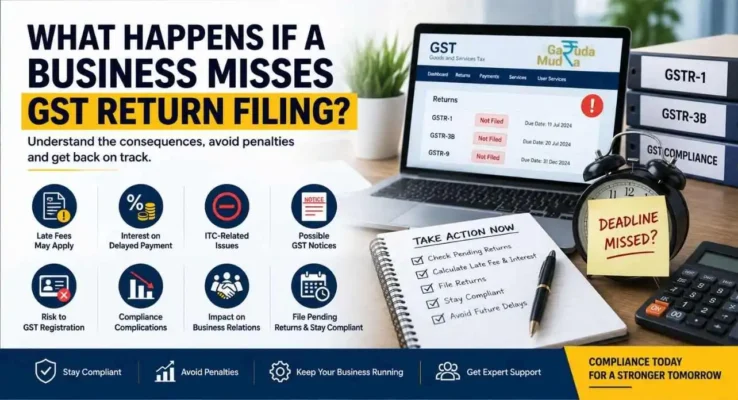
Missing a GST return filing deadline in India does not mean that your business is automatically shut down or that you will immediately face a major penalty. However, delayed GST return filing can create real financial and compliance consequences — late fees, interest on delayed tax payment, complications with subsequent filings, Input Tax Credit problems and, in prolonged cases, action relating to GST registration.
Quick Answer: If a GST-registered business misses a return deadline, it may face late filing fees, interest on delayed tax payment, additional cash outflow, problems claiming or reconciling Input Tax Credit, difficulties with subsequent GST compliance, and — in prolonged or default situations — notices, recovery proceedings or registration-related consequences. The exact outcome depends on the return type, tax liability, filing delay, taxpayer category and applicable GST provisions and notifications.
On this page
- Is Filing Mandatory?
- What Counts as a Missed Return?
- 13 Consequences of Missing a Return
- What Should You Do If You Missed One?
- Missed Several Months?
- No Sales — Still Need to File?
- Can Late Fee Be Waived?
- GSTR-1 vs GSTR-3B
- Common Reasons Businesses Miss Deadlines
- How to Avoid Missing Returns
- Pending Returns Checklist
- FAQs
Is GST Return Filing Mandatory?
If your business is registered under GST and is required to furnish a particular return or statement, filing it is part of your GST compliance responsibility — this can apply even when there is little or no business activity. However, a nil return is not automatically available simply because you had no sales. The GST Portal states that GSTR-3B can be filed as a nil return only when the prescribed nil-filing conditions are satisfied, including no outward supply, no relevant inward supplies, no ITC claim or reversal, and no outstanding interest or late-fee liability. In short: no sales does not always mean “no GST return required.”
What Is Considered a Missed GST Return?
A GST return is considered delayed when it is not filed by the applicable statutory due date. Common GST compliance filings include GSTR-1, GSTR-3B, GSTR-4 and other composition-related forms where applicable, the GSTR-9 annual return where applicable, GSTR-9C where applicable, and other statements depending on the taxpayer. Not every GST-registered business files every form — the applicable requirement depends on registration type, scheme, turnover, business activity and other conditions.
What Happens If You Miss GST Return Filing? (13 Consequences)
1
Late Fee Can Apply
For GSTR-3B, the GST Portal explains that late fee is system-computed based on the number of days after the due date. Filing guidance states a computation of ₹25/day under CGST and ₹25/day under SGST/UTGST where there is liability, and ₹10/day under each for nil liability, subject to applicable statutory caps and notifications. The actual amount depends on whether the return is nil, whether tax is payable, the number of days delayed, the applicable cap, taxpayer category, and any waiver notification. Do not calculate today’s late fee using an old article or outdated example — GST late-fee rules have changed over time; always check the current GST Portal calculation.
2
Interest Can Apply on Delayed Tax Payment
Late filing and delayed tax payment are related but not identical. If tax was payable and payment is delayed, interest may become payable under applicable GST provisions. For example, on a ₹1,00,000 liability filed late, you may owe the tax liability plus applicable interest plus applicable late fee — the exact calculation depends on the nature of the liability, payment, delay and applicable rules.
3
Late Fee and Interest Are Not the Same
Late fee is a charge for delayed filing. Interest is a charge for delayed payment of tax. Filing late can create a late-fee issue, while paying tax late can create an interest issue — in some situations, both can apply. The GST Portal separately displays interest and late-fee components while processing delayed GSTR-3B filing.
4
Your Compliance Cost Increases With Every Day of Delay
A small delay may seem harmless, but the longer a return remains unfiled, the more the financial and administrative consequences can grow.
Missed Due Date→
Late Fee Accrues→
Interest Accrues→
Next Return Harder→
Backlog Increases
5
You May Face Problems With Input Tax Credit
If returns aren’t filed properly or GST records remain unresolved, ITC reconciliation and reporting can become more complicated — purchase records need to be compared against GSTR-2B, ITC records and GSTR-3B, and a delayed filing can create a backlog in that process. See our detailed guide on small business GST and compliance management.
6
Missing GSTR-1 Can Affect Your Customers
If you sell to another GST-registered business, your customer expects invoice information to appear in the GST system for their own reconciliation and ITC. Delayed or incorrect outward-supply reporting can create a mismatch, leading to customer follow-ups, reconciliation issues, ITC questions and even commercial disputes. Your GST compliance can affect your customers’ compliance too.
7
Delayed Filing Can Create a Compliance Backlog
Miss April’s GSTR-3B and keep operating, and by June the accounting team is juggling April’s pending return alongside May and June’s records, new sales, new purchases and new ITC. The longer the delay continues, the harder reconciliation becomes — avoid the mindset of “I’ll file everything together later.”
8
You May Not Be Able to File a Nil Return
“There was no business, so I can simply select Nil” isn’t always true. If there’s outstanding interest or late fee, ITC to report, reverse-charge liability, relevant inward supplies or other reportable transactions, the return may not qualify as nil.
9
Continued Non-Filing Can Become More Serious
A single late return is different from repeatedly ignoring GST compliance. Prolonged non-compliance can lead to GST notices, recovery of outstanding tax, interest, penalties where applicable, registration-related action, difficulty restoring normal compliance, and additional professional/administrative costs — depending on the circumstances.
10
GST Registration Can Face Consequences in Prolonged Default
GST law allows for registration cancellation in certain cases involving failure to furnish returns, but one missed return does not mean automatic cancellation. The applicable rules, return type, number of consecutive defaults, notices and prescribed procedures all matter — don’t rely on oversimplified claims like “one missed GST return means GST cancellation.”
11
You May Receive a GST Notice
A notice does not automatically mean fraud has occurred — it may relate to non-filing, tax dues, mismatches, ITC, return discrepancies or registration. Read it carefully and identify the period involved, the return or issue mentioned, the amount demanded, the response deadline and the supporting documents required. Ignoring a GST notice can make the situation more difficult.
12
Your GST Records May Become Difficult to Reconcile
Three months of pending returns alongside 500 purchase invoices, 300 sales invoices, multiple credit notes, multiple suppliers, ITC and reverse-charge transactions is far harder to reconstruct months later than to reconcile monthly — increasing accounting time, professional fees, error risk and compliance stress.
13
Delayed GST Filing Can Affect Business Finance
When applying for business finance, lenders may review financial and tax records as part of their assessment. Incomplete, delayed or inconsistent GST records can trigger additional questions during due diligence — GST compliance is part of maintaining a finance-ready business.
What Should You Do If You Missed a GST Return?
Do not panic. Do not ignore it. Follow a structured process:
- Identify the Missed ReturnDetermine whether it’s GSTR-1, GSTR-3B, a composition-related filing, the annual return, or another applicable statement.
- Check the Return PeriodIdentify exactly which month, quarter or financial year is pending — “GSTR-3B, July 2026” is easier to resolve than “my GST is pending.”
- Check Whether Tax Is PayableReview sales, output GST, reverse-charge liability, ITC and tax already paid to calculate the actual outstanding amount.
- Reconcile Your BooksCompare your sales register, purchase register, GST returns, GSTR-2B, tax liability and cash/credit ledger before filing, to avoid submitting incorrect information while rushing to clear the backlog.
- Check Interest and Late FeeThe GST Portal calculates applicable interest and late fee during filing and allows review/recomputation where applicable. Don’t rely on an old online calculator.
- File the Pending ReturnPrepare → Review → Pay the applicable amount → File → Download the acknowledgement, and keep it with your accounting records.
- Reconcile the Next ReturnConfirm previous-period figures, ITC adjustments, and interest/late-fee entries are properly reflected in the subsequent filing.
What If You Missed GST Returns for Several Months?
This needs more careful handling. Don’t simply start filing random returns without understanding the backlog — build a return-wise table first:
| Return Period | Return | Tax Payable | ITC | Late Fee | Interest | Status |
|---|---|---|---|---|---|---|
| April | GSTR-3B | ₹ | ₹ | ₹ | ₹ | Pending |
| May | GSTR-3B | ₹ | ₹ | ₹ | ₹ | Pending |
| June | GSTR-3B | ₹ | ₹ | ₹ | ₹ | Pending |
Then resolve the backlog systematically, in the recommended order: Oldest pending return → Reconcile → Calculate liability → File → Confirm → Move to next period. This prevents the business from losing track of which period has been cleared.
What If You Missed Filing Even Though There Were No Sales?
This is a common situation. If you had no sales, check whether you truly qualify for a nil return — for GSTR-3B, this requires no relevant outward or inward supplies, no ITC claim/reversal, no relevant tax liability, and no outstanding interest or late fee. No sales ≠ automatically no GST filing obligation. If your registration remains active but the business is genuinely inactive, don’t simply stop filing — determine whether the return is required, and consider whether the registration itself should remain active or be cancelled/surrendered under the applicable rules.
Can GST Late Fee Be Waived?
GST authorities have issued various notifications and relief measures at different times for specified taxpayers and tax periods — for example, Notification No. 19/2021-Central Tax introduced late-fee rationalisation for GSTR-3B from June 2021 onward with certain conditional relief for older periods. However, don’t assume an old amnesty or waiver is currently available. If you have a pending return today, check the current GST Portal and applicable notification for that specific period.
Not every delayed return automatically results in a separate penalty either. CBIC has clarified that where self-assessed tax and applicable interest are paid through delayed GSTR-3B filing, the specific penalty under Section 73(11) is generally not invoked merely because the return was filed late — although other provisions can apply depending on circumstances. Avoid relying on blanket claims such as “late GST filing always attracts a 10% penalty”; GST consequences are more nuanced than that.
GSTR-1 vs GSTR-3B: What Happens If You Miss Each?
If GSTR-1 Is Missed
GSTR-1 reports outward supplies. Delayed filing can affect customer invoice visibility, customer reconciliation, ITC-related processes, your own compliance and subsequent return preparation. The exact late fee depends on applicable law and taxpayer category.
If GSTR-3B Is Missed
GSTR-3B declares tax liabilities and eligible ITC and discharges the applicable tax liability. A delayed GSTR-3B can mean late fee, interest where applicable, additional cash requirement, ITC/reconciliation complications and subsequent filing issues.
Not every taxpayer files the same way — depending on eligibility and scheme, you may have monthly filing, quarterly filing, composition-related compliance or annual compliance. Your GST compliance calendar should be based on your actual registration and filing scheme. Learn more about our GST Return Filing services.
Common Reasons Businesses Miss GST Filing Deadlines
Accounting Data Not Ready
The accountant is still waiting for invoices.
Owner Forgot the Due Date
There was no internal compliance calendar.
Cash Flow Problems
The business has tax liability but insufficient cash to pay it.
Supplier Data Not Reconciled
Purchase invoices don’t match GSTR-2B.
Accounting Team Delays
Documents reach the accountant too late.
Business Is Inactive
The owner assumes no business means no filing.
Registration Taken, Business Never Started
The registration remains active even though operations didn’t begin.
Internal Responsibility Unclear
Nobody knows who is responsible for filing.
How Can a Business Avoid Missing GST Returns?
- Close Sales & Purchase RecordsKeep the sales and purchase registers current, not reconstructed after the fact.
- Reconcile Bank TransactionsMatch bank activity with your books each month.
- Review GSTR-2B and ITCCheck eligible credit before it becomes a last-minute scramble.
- Check GSTR-1/GSTR-1A InformationVerify outward-supply reporting is accurate and current.
- Calculate GSTR-3B LiabilityWork out output tax, ITC and reverse-charge liability in advance.
- Arrange Tax Payment FundsEnsure cash flow is planned around the payment date, not scrambled together at the deadline.
- File Before the DeadlineBuild in a buffer rather than filing on the last possible day.
- Save the Filed Return and AcknowledgementKeep records organised for future reconciliation and audits.
This turns GST compliance into a routine rather than a last-minute emergency. Our accounting and bookkeeping services can help build exactly this kind of monthly process for your business.
What Should a Business Do If GST Returns Are Already Pending?
- Identify every pending return
- Check the exact tax period
- Download available GST records
- Update accounting books
- Reconcile sales & purchases
- Review GSTR-2B
- Calculate output tax
- Calculate eligible ITC
- Check reverse-charge liability
- Review cash/credit ledgers
- Check system-calculated interest
- Check applicable late fee
- File the oldest pending return
- Confirm successful filing
- Repeat for remaining periods
- Bring current-period filing up to date
Common Compliance Mistakes to Avoid
- Assuming No Sales Means No FilingNil-filing has specific conditions — it isn’t automatic.
- Filing Random Periods Out of OrderWithout a period-wise reconciliation table, it’s easy to lose track of what’s actually been cleared.
- Relying on Old Late-Fee/Waiver InformationNotifications and relief schemes change — always check the current GST Portal rules.
- Ignoring a GST NoticeDelayed response can make the situation more difficult to resolve.
- Treating It as “Just a Late Fee” ProblemProlonged non-filing carries reconciliation, ITC, and potentially registration-related risk.
When Should You Take Professional GST Help?
Professional assistance can be especially useful when multiple GST returns are pending, your registration is at risk, you’ve received a GST notice, your books and GST returns don’t match, GSTR-2B and purchase records show major differences, there’s substantial outstanding tax, your business has multiple GST registrations or interstate/e-commerce transactions, previous returns contain errors, or you’re unsure whether a return can be filed as nil. A professional can help determine the correct sequence for clearing the backlog rather than simply filing returns without reconciliation.
Frequently Asked Questions
What happens if I miss a GST return filing?
You may face late fees and, where tax payment is delayed, interest. Continued non-compliance can also create reconciliation problems, notices and other consequences depending on the circumstances.
Is there a penalty for filing GST returns late?
Late fees generally apply to delayed filing, while additional penalties depend on the nature of the default and applicable provisions. Not every late return automatically results in a separate penalty.
What happens if I miss GSTR-3B?
You may have to pay applicable late fees and interest where tax payment is delayed. The GST Portal calculates these amounts based on the relevant filing information.
What happens if I miss GSTR-1?
Delayed GSTR-1 filing can affect your own compliance and may also affect customers who rely on your outward-supply reporting for GST reconciliation.
Can I file a GST return after the due date?
Depending on the return and applicable rules, a delayed return can generally be filed subject to the applicable late fee, interest and other conditions.
What if I had no sales during the month?
You may need to file a nil return if the applicable nil-filing conditions are satisfied. No sales alone does not necessarily mean the return can automatically be filed as nil.
Does GST late fee increase every day?
For applicable returns, late fee can be calculated based on the number of days of delay, subject to the applicable statutory limits and notifications. The GST Portal provides system calculations for relevant returns.
Can GST late fee be waived?
Relief or waiver may be provided through specific government notifications for specified taxpayers and periods. Businesses should check the current applicable notification rather than relying on historical amnesty schemes.
Can missing GST returns affect Input Tax Credit?
Delayed or inaccurate filing can complicate ITC reporting and reconciliation. Businesses should review GSTR-2B, purchase records and applicable ITC conditions before claiming credit.
Can GST registration be cancelled for non-filing?
Prolonged or repeated non-compliance can lead to registration-related action under applicable GST provisions. However, a single missed return does not automatically mean immediate cancellation.
Can a GST notice be issued for non-filing?
Yes, GST authorities can take appropriate action or communicate with taxpayers regarding non-compliance, depending on the circumstances.
Should I stop filing GST returns if my business is inactive?
No. If your GST registration remains active, determine the applicable filing obligation rather than simply stopping returns.
Final Takeaway
Missing a GST return should never be ignored. A delayed filing can create a chain: late fee → interest → reconciliation issues → ITC problems → compliance backlog → potential notices or other consequences. The best response is to act quickly. If a return has already been missed: identify the return, reconcile the books, calculate tax, check interest and late fee, file, confirm, and bring subsequent returns up to date. If several returns are pending, don’t guess — prepare a period-wise compliance statement and resolve the backlog systematically.
For Indian small businesses, maintaining a monthly GST compliance and reconciliation process is usually far easier than trying to reconstruct several months of records after a missed filing.
Need Help With Pending GST Returns?
Garuda Mudra can help businesses review and organise their GST, accounting and tax compliance requirements — pending returns, GSTR-3B/GSTR-1 delays, late fees, interest calculations, GSTR-2B mismatches, ITC reconciliation and GST notices. Don’t let one missed GST return become a long-term compliance backlog.
Disclaimer: This article is intended for general informational purposes for businesses in India and is not a substitute for professional tax or legal advice. GST rates, filing procedures, late fees, interest calculations, deadlines, exemptions, waiver notifications and other compliance requirements can change. The exact consequences of a missed return depend on the taxpayer, return type, tax period, liability and applicable law. Businesses should verify the current requirements on the GST Portal and with a qualified GST/tax professional before taking action.
One thought on “What Happens If a Business Misses GST Return Filing?”