
Need help? Call us:
+91-9711029902
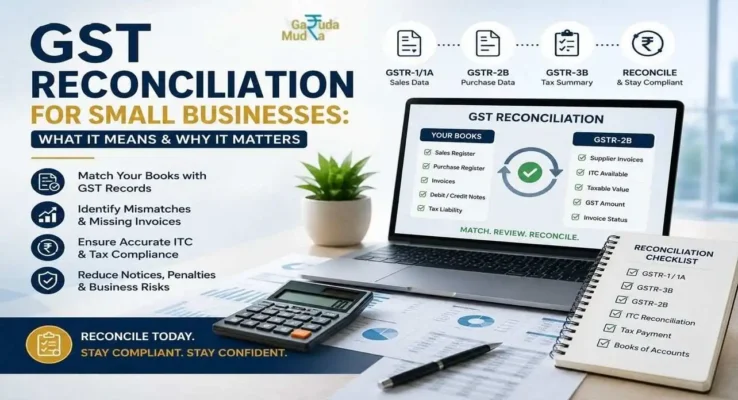
For a small business in India, filing GSTR-1 and GSTR-3B on time is only half the job. Mismatches, incorrect Input Tax Credit (ITC), missing invoices, duplicate entries and books-vs-returns differences can still creep in — and that’s exactly what GST reconciliation is designed to catch.
Quick Answer: GST reconciliation means comparing your books of accounts, sales and purchase records, GST returns and GST-system data to identify differences. For businesses claiming ITC, it commonly involves comparing purchase records with GSTR-2B and checking whether invoices, tax amounts and other details are correctly reflected and eligible.
On this page
- What Is GST Reconciliation?
- Why It Matters for Small Businesses
- Filing vs. Reconciliation
- Records You Should Reconcile
- GSTR-2B Reconciliation
- Common Reconciliation Differences
- Reconciliation and ITC
- What Is IMS?
- Step-by-Step Process
- Reconciliation Checklist
- How Often to Reconcile
- Common Mistakes
- By Business Type
- Software vs. Manual
- FAQs
A business may file its GSTR-1 and GSTR-3B on time and still have GST mismatches, incorrect ITC, missing invoices, duplicate entries, credit-note differences or differences between books and GST returns. Regular reconciliation helps improve the accuracy of GST returns, reduces avoidable errors, identifies missing purchase invoices and supports proper ITC management.
What Is GST Reconciliation?
GST reconciliation is the process of comparing different sets of financial and GST data to make sure they are consistent. For a typical GST-registered business, this can involve comparing the following chain of records:
Books of Accounts→
Sales & Purchase Register→
GSTR-1 / 1A→
GSTR-3B→
GSTR-2B→
Tax Payments & ITC Records
The purpose is to identify differences before they become larger compliance problems. For example, your purchase register may show an invoice for ₹1,00,000 + GST, but the corresponding supplier invoice may not yet appear in the relevant GST-system data. That difference needs to be investigated — it could be because the supplier hasn’t filed the invoice, reported an incorrect GSTIN or invoice number, reported it in another period, amended or cancelled it, or because there’s a timing difference or the ITC simply isn’t eligible for another reason.
Why Is GST Reconciliation Important for Small Businesses?
Small businesses often operate with limited accounting resources — the owner may be juggling sales, customers, employees, vendors, banking, inventory, tax payments and GST returns all at once. Because of this, small errors can easily go unnoticed. Regular reconciliation helps identify problems before they accumulate.
Better GST Accuracy
Improves the accuracy of returns and reduces avoidable errors.
Better ITC Tracking
Early identification of missing invoices and ITC gaps.
Cleaner Records
Identifies duplicate or incorrect entries before year-end.
Supplier Coordination
Improves follow-up on unfiled or incorrect supplier invoices.
Reduced Dispute Risk
Lowers the risk of avoidable GST disputes and notices.
Stronger Compliance
Better visibility into tax liabilities and year-end preparation.
The GST Portal itself explains that system-generated GSTR-3B uses information from GSTR-1/1A and GSTR-2B, and is intended to assist taxpayers, minimise errors and support long-term reconciliation.
What Is the Difference Between GST Reconciliation and GST Return Filing?
GST Return Filing
Submitting the required information and tax liability through the GST system. In simple terms — filing tells the government what you reported.
GST Reconciliation
Checking whether the information in your books and GST records matches, and investigating differences. Reconciliation helps you verify whether what you reported is correct and properly supported.
A business can file its returns on time and still have unresolved reconciliation issues sitting underneath.
What Records Should a Small Business Reconcile?
1. Sales Register
Compare your sales register with the outward supplies reported through GST returns. Check invoice number, invoice date, customer GSTIN, taxable value, GST rate, CGST/SGST/IGST, credit notes, debit notes and amendments.
2. Purchase Register
Compare your purchase register against GST-system data. Check supplier GSTIN, invoice number and date, taxable value, tax amount, credit/debit notes, ITC eligibility and invoice status.
3. GSTR-1 / GSTR-1A
Your outward-supply reporting should be checked against your sales records. The GST Portal currently provides GSTR-1A as a facility for adding missed records or amending certain records before filing GSTR-3B for the relevant tax period.
4. GSTR-3B
GSTR-3B should be reviewed against sales, tax liability, ITC, reverse-charge liability (where applicable), tax payments and previous-period adjustments. The GST Portal’s system-generated GSTR-3B uses information from GSTR-1/1A, GSTR-2B and the previous period’s GSTR-3B as assistance for preparing the return.
5. GSTR-2B
GSTR-2B is particularly important when reviewing ITC. It is described as an auto-drafted ITC statement based on information furnished by suppliers and other specified sources — a static statement generated for each period. Your accounting team should compare eligible purchase records with GSTR-2B and investigate differences.
What Is GSTR-2B Reconciliation?
GSTR-2B reconciliation generally means comparing eligible purchase/ITC records in your books with the information appearing in GSTR-2B and identifying differences. A simple example:
| Source | Supplier | Invoice | Taxable Value | GST |
|---|---|---|---|---|
| Your Purchase Register | ABC Pvt Ltd | 1058 | ₹50,000 | ₹9,000 |
| GSTR-2B | — | Not Found | — | — |
This creates a reconciliation difference. Instead of simply claiming the ITC without investigation, the business should determine why the invoice is missing and whether the credit is otherwise eligible under the applicable GST provisions.
Common GST Reconciliation Differences
1. Invoice Missing in GSTR-2B
Books show the purchase, but the supplier’s invoice isn’t reflected — often due to unfiled returns, wrong GSTIN, wrong invoice details or a different reporting period.
2. GST Amount Mismatch
Books show one GST figure, GST-system data shows another — due to rate errors, data entry, amendments, credit/debit notes or rounding.
3. Invoice Number Mismatch
E.g. Books show INV-1058, GST data shows INV-1059 — genuine but hard for automated matching.
4. GSTIN Mismatch
An incorrectly entered or reported supplier GSTIN can prevent invoices from matching properly.
5. Duplicate Invoice
The same invoice entered twice can inflate ITC if both entries are considered.
6. Credit Note Difference
Unrecorded or mismatched credit notes affect taxable value, output tax, ITC and party balances.
7. Timing Differences
A purchase recorded in April but reported by the supplier in a later period — not necessarily an error.
8. Sales Register vs GSTR-1
Total taxable sales in your books differs from what’s reported as outward supplies — investigate before it snowballs.
GST Reconciliation and Input Tax Credit
One of the most important reasons businesses perform GST reconciliation is Input Tax Credit (ITC). Eligible ITC can reduce the GST payable on outward supplies, subject to the conditions and restrictions under GST law. Section 16 of the CGST Act provides the framework for eligibility and conditions for claiming ITC, while other provisions restrict or block certain credits. Seeing an invoice in your accounting software does not automatically mean the GST credit can be claimed without checking the applicable conditions.
A proper ITC review should consider whether the purchase is for business purposes, whether the tax invoice or prescribed document is available, whether the relevant supplier reporting is reflected, whether the credit is eligible or restricted, whether payment-related conditions apply, whether the credit has already been claimed, and whether any reversal is required.
What Is IMS and Why Does It Matter for GST Reconciliation?
The Invoice Management System (IMS) on the GST Portal lets taxpayers review invoice records reported by suppliers and accept, reject or keep eligible records pending, subject to applicable rules. Records accepted by the recipient become part of the ITC-available section of the relevant GSTR-2B, while rejected records do not flow into GSTR-3B as eligible ITC. Recipients can take actions after the draft GSTR-2B is generated, up to the filing of GSTR-3B. This makes reconciliation more than comparing two spreadsheets — it should be treated as an ongoing GST-control process.
How to Perform GST Reconciliation Step by Step
- Export Your Purchase RegisterDownload purchase data from your accounting software — supplier GSTIN, invoice number/date, taxable amount, CGST/SGST/IGST and total invoice value.
- Download Relevant GST DataCollect GSTR-2B and other applicable GST return data for the period.
- Standardise the DataAlign GSTIN formats, invoice numbers, date formats, and correctly separate tax amounts, credit and debit notes.
- Match InvoicesMatch records using GSTIN + Invoice Number + Invoice Date + Taxable Value + Tax Amount.
- Categorise DifferencesSort each result into Matched, Books Only, GST Data Only, Amount Mismatch, Duplicate, Timing Difference, or Credit/Debit Note Difference.
Example of a GST Reconciliation Statement
| Invoice | Books | GSTR-2B | Difference | Action |
|---|---|---|---|---|
| INV-101 | ₹9,000 ITC | ₹9,000 ITC | ₹0 | Matched |
| INV-102 | ₹5,400 ITC | Not Found | ₹5,400 | Check Supplier |
| INV-103 | ₹7,200 ITC | ₹6,300 ITC | ₹900 | Investigate |
| INV-104 | ₹3,600 ITC | ₹3,600 ITC | ₹0 | Matched |
| INV-105 | ₹4,500 ITC | Duplicate | — | Review |
GST Reconciliation Checklist for Small Businesses
Sales
- Sales register updated
- GST invoices checked
- Credit & debit notes recorded
- GSTR-1/1A reviewed
- GSTR-3B reviewed
Purchases & ITC
- Purchase register updated
- Supplier GSTIN checked
- Invoice numbers checked
- GST amounts checked
- Duplicate invoices removed
- Missing invoices identified
- GSTR-2B reviewed
- Eligible / ineligible ITC identified
- Reversals & reclaims checked
Payments & Records
- GST liability calculated
- Cash/credit ledger reviewed
- Tax payments reconciled
- Reconciliation report saved
- Differences documented
- Supplier follow-ups recorded
How Often Should a Small Business Perform GST Reconciliation?
There is no single frequency that suits every business. However, monthly reconciliation is generally a strong practice for businesses with regular GST transactions, because it allows problems to be identified closer to the transaction period. For lower-volume businesses, the process may be structured differently depending on filing frequency and internal systems. The key principle: don’t wait until the end of the financial year to discover months of unresolved GST differences.
Purchase Register→
GSTR-2B→
Reconciliation→
Supplier Follow-up→
ITC Review→
GSTR-3B
The GST Portal currently provides system-generated assistance for GSTR-3B using GSTR-1/1A and GSTR-2B information, but explicitly notes that these generated values are not final and remain editable by the taxpayer. Businesses should not simply accept system-generated figures without reviewing the underlying records.
GST Reconciliation Before Annual Filing
Reconciliation becomes particularly important when preparing for year-end GST compliance. Businesses should review books of accounts against GST returns, GSTR-2B/ITC records and tax paid — and appropriately document any significant differences. GSTN’s materials on annual return/reconciliation also demonstrate the importance of reconciling turnover, tax paid and ITC where applicable requirements apply.
What Happens If GST Reconciliation Is Not Done?
Failing to reconcile GST data does not automatically mean a business will receive a notice. However, unresolved differences can create avoidable risks — incorrect or excess ITC claims, missed eligible ITC, incorrect tax liability, duplicate entries, unresolved supplier mismatches, difficulty responding to GST queries, complicated year-end reconciliation, and additional interest or other consequences where tax becomes payable. The exact consequences depend on the nature of the discrepancy and the applicable provisions.
Common GST Reconciliation Mistakes
Checking Only GSTR-2B
Reconciliation shouldn’t be reduced to one report — consider books, invoices, returns, ITC eligibility and payments together.
Assuming Every GSTR-2B Invoice Is Eligible
Appearing in GST data doesn’t override the legal conditions applicable to ITC.
Ignoring Supplier Errors
Incorrect GSTIN, invoice number or tax amount from a supplier can break the match — communicate proactively.
Reconciling Only at Year-End
By then it’s difficult to remember why a transaction differed months earlier.
Ignoring Credit/Debit Notes
These significantly affect taxable value and GST — track them separately.
Treating Books & GST as Separate Systems
Your accounting records and GST records should ultimately tell one coherent financial story.
GST Reconciliation for Different Types of Small Businesses
Retail Business
High-volume sales, purchase invoices, GST rates, credit notes, inventory, ITC.
Service Business
Service invoices, GST rates, B2B customer GSTINs, expenses, vendor invoices, ITC.
E-commerce Business
Marketplace transactions, sales reconciliation, TCS-related records, returns/refunds, customer invoices.
Manufacturing Business
Raw materials, input services, ITC, purchase records, job work, stock records, sales & tax reporting.
Can GST Reconciliation Help Recover Missed ITC?
Potentially, yes. A reconciliation exercise may identify invoices or eligible credits that weren’t properly captured in your accounting records. However, identifying an invoice doesn’t automatically mean the ITC can be claimed — the business must verify whether the credit is legally eligible and whether it can still be claimed within the applicable time limits and conditions.
GST Reconciliation Software vs Manual Reconciliation
| Approach | Advantages | Disadvantages |
|---|---|---|
| Manual (Excel / accounting software) | Low initial cost; suitable for smaller volumes; easy to customise | Time-consuming; higher manual-error risk; difficult at scale |
| Automated Reconciliation Software | Faster matching; duplicate detection; exception reporting; easier monthly tracking; less manual effort | Still needs professional review — software should support, not replace, human judgement |
When Should You Get Professional Help With GST Reconciliation?
Professional assistance can be particularly useful if your business has many invoices, significant ITC, regular GST mismatches, multiple GST registrations, interstate or reverse-charge transactions, e-commerce transactions, a GST notice already received, or if your team lacks in-house GST expertise. A professional can turn reconciliation from a last-minute activity into a structured compliance process — this is exactly where Garuda Mudra’s accounting and bookkeeping team can step in.
Frequently Asked Questions
What is GST reconciliation?
GST reconciliation is the process of comparing business accounting records with GST returns and GST-system data to identify and resolve differences in sales, purchases, tax liability and Input Tax Credit.
Why is GST reconciliation important for small businesses?
It helps identify missing invoices, incorrect tax amounts, duplicate entries, ITC differences and mismatches between books and GST returns before they become larger compliance issues.
What is GSTR-2B reconciliation?
It involves comparing purchase/ITC records in your books with the relevant GSTR-2B information and investigating differences before determining eligible ITC.
Is GSTR-2B the same as GSTR-2A?
No. GSTR-2B is a system-generated ITC statement with a static, period-based approach, while GSTR-2A is a dynamic statement that can change as suppliers upload or amend information.
Should I claim every ITC appearing in GSTR-2B?
No. ITC eligibility depends on applicable GST law and conditions. An invoice appearing in GST-system data does not by itself make every credit automatically eligible.
How often should GST reconciliation be done?
Monthly reconciliation is a practical approach for many businesses, allowing differences to be identified and resolved promptly. The right frequency depends on transaction volume, filing frequency and internal controls.
What if an invoice is missing from GSTR-2B?
Check whether the supplier has correctly reported the invoice, whether the GSTIN and invoice details are correct, and whether it may appear in another period. Follow up with the supplier where necessary.
Can GST reconciliation identify excess ITC?
Yes. It can help identify duplicate invoices, incorrect tax amounts, credit notes and other situations where recorded ITC may not match the relevant GST data.
Can GST reconciliation help identify missed ITC?
It can help identify purchase invoices or eligible credits not correctly captured in the accounting records — though the credit must still satisfy applicable legal conditions and time limits.
Does GST reconciliation prevent GST notices?
No process can guarantee a business will never receive a GST notice. However, accurate and reconciled records help reduce avoidable errors and make it easier to respond to queries.
Final Takeaway
GST reconciliation is not just an accounting exercise — it is an important GST-control process for small businesses in India. A business should aim to keep its books, invoices, GSTR-1/1A, GSTR-3B, GSTR-2B, ITC and tax payments aligned. When these records are regularly compared, businesses can identify discrepancies earlier, investigate supplier issues, improve ITC management and maintain cleaner GST records. Don’t wait until the annual return or a GST notice to discover your GST mismatches — reconcile regularly.
Need Help With GST Reconciliation?
Garuda Mudra helps businesses manage GST, accounting, tax and compliance requirements with a structured approach to financial records and regulatory reporting. If you’re facing GST mismatches, ITC differences, missing invoices or GSTR-2B discrepancies, our team can help identify the underlying issue and the right next step.
Disclaimer: This article provides general information for businesses in India and is not a substitute for professional tax or legal advice. GST rules, forms, filing procedures, thresholds, deadlines and ITC conditions may change through legislation, notifications, circulars and GST Portal updates. Businesses should verify the current requirements applicable to their GST registration and transactions before taking action.