
Compliance Guide · India
Small Business Compliance Checklist in India (2026 Guide)
Everything a proprietorship, partnership, LLP or private limited company needs to track — GST, income tax, TDS, ROC/MCA filings, payroll and local registrations — explained in one place by Garuda Mudra.
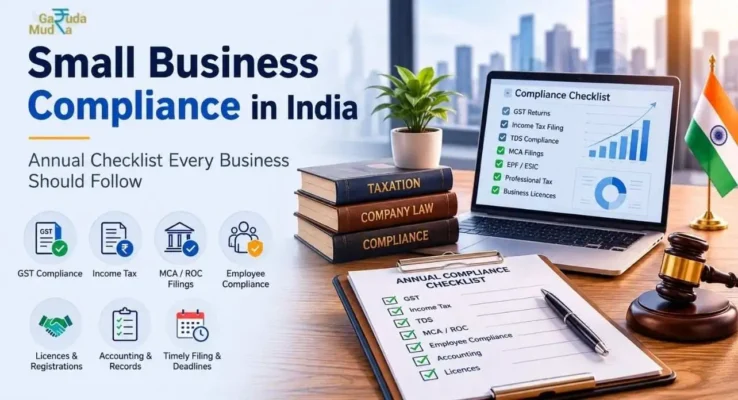
A small business in India may need to manage income-tax returns, GST returns, TDS compliance, bookkeeping and financial records, MCA/ROC filings, payroll-related compliance, professional tax, Shops & Establishments requirements and industry-specific licences. Not every business needs every compliance — the applicable requirements depend on business structure, turnover, employees, location and nature of business.
Running a small business in India involves much more than generating sales and managing customers. Every business also has tax, accounting, GST, employee, corporate and legal compliance responsibilities. The exact requirements depend on the business structure and activities — a sole proprietorship, partnership firm, LLP and private limited company do not have the same annual compliance obligations.
For many business owners, the biggest challenge is not understanding that compliance is important — it is knowing which compliances apply, when they are due, what records need to be maintained and what happens if a filing is missed. This guide explains the major annual and recurring compliance requirements for small businesses in India.
What Is Business Compliance in India?
Business compliance means following the laws, regulations, tax requirements and reporting obligations applicable to your business. Compliance is not a single annual activity — some obligations are monthly, some quarterly, some annual and some event-based.
- Income-tax return filing
- GST registration and return filing
- TDS deduction and reporting
- Maintenance of books of accounts and annual financial statements
- MCA/ROC filings
- Employee-related compliance, including EPF and ESIC where applicable
- Professional Tax, where applicable
- Shops and Establishments compliance
- Business licence renewals and industry-specific registrations
- Record keeping and document maintenance
Small Business Compliance Checklist
This is a general checklist, not a universal list. Your actual compliance calendar should be prepared based on your legal structure, state, turnover, employees and business activity.
| Compliance Area | Who May Need It? | Frequency |
|---|---|---|
| Income-tax return | Businesses and professionals as applicable | Annual |
| Advance tax | Taxpayers meeting applicable conditions | Periodic |
| GST returns | GST-registered businesses | Monthly/Quarterly + annual where applicable |
| TDS | Businesses required to deduct TDS | Periodic |
| Bookkeeping | Businesses subject to accounting requirements | Ongoing |
| MCA/ROC filings | Companies and LLPs | Annual/periodic |
| EPF | Covered establishments/employers | Monthly |
| ESIC | Covered employers | Monthly |
| Professional Tax | Where applicable under state law | Periodic |
| Shops & Establishments | Depending on state and establishment | State-specific |
| Business licences | Depending on business activity | Periodic/annual as applicable |
1. Income Tax Compliance
Income-tax compliance is one of the most important recurring obligations for a business. Businesses generally need to:
- Maintain appropriate financial records and calculate taxable income
- Track business expenses and reconcile income and tax information
- Pay advance tax where applicable
- File the applicable income-tax return
- Complete tax audit requirements where applicable
- Maintain supporting documents
The applicable return depends on the type of taxpayer. For AY 2026–27, ITR-3 applies to eligible individuals/HUFs with business or professional income, while ITR-4 may apply to eligible taxpayers using presumptive taxation.
Does every small business need a tax audit?
No. Tax audit requirements depend on the nature and level of business or professional receipts. For FY 2025–26, the tax-audit threshold remains at ₹1 crore for business, increasing to ₹10 crore where cash receipts and payments do not exceed 5% of relevant totals; for professions, the threshold is ₹50 lakh, subject to applicable conditions. Because rules can change, always check the applicable rules for the relevant financial year.
2. GST Compliance
If your business is registered under GST, GST compliance becomes a regular part of operations, including:
- GST invoices, sales and purchase records, and Input Tax Credit records
- GSTR-1 and GSTR-3B
- Annual return requirements where applicable (GSTR-9)
- GST payment and reconciliation
- E-invoicing/e-way bill requirements where applicable
Normal taxpayers generally file GSTR-3B for each tax period. Monthly filers generally have a 20th-of-the-following-month due date, while quarterly filers have state/UT-specific 22nd or 24th due dates. GSTR-9 is the annual return for applicable regular taxpayers.
Why GST reconciliation matters
A common problem is a mismatch across sales records → GST returns → purchase records → Input Tax Credit → books of accounts. Regular reconciliation helps catch errors before they become larger compliance problems.
3. TDS Compliance
TDS may apply to payments such as professional fees, contractor payments, rent, commission, interest, salary and other specified payments. Where applicable, businesses need to:
- Determine whether TDS is applicable
- Deduct the appropriate amount
- Deposit the tax within the applicable time
- File the relevant TDS statement
- Issue applicable TDS certificates
- Reconcile TDS records with books and tax information
Incorrect or delayed TDS compliance can result in interest, fees or penalties, so treat it as part of regular accounting rather than a year-end task.
4. Bookkeeping and Accounting Compliance
Good bookkeeping is the foundation of business compliance. Maintain accurate records of sales, purchases, expenses, bank and cash transactions, receivables, payables, loans, assets, liabilities, GST, TDS and payroll. Accurate accounting helps you understand the flow from Revenue → Expenses → Profit → Cash Flow → Tax → Financial Position, and makes GST, income-tax, loan applications and financial planning easier.
5. MCA/ROC Compliance for Companies
Private Limited Companies, OPCs and other company structures have additional corporate compliance, including statutory records, financial statements, annual returns, board and AGM-related compliance, director filings, auditor compliance and event-based MCA filings. The MCA uses AOC-4 for financial statements and MGT-7/MGT-7A for annual returns (MGT-7A applies to OPCs and small companies).
A private limited company cannot treat annual compliance as optional just because it is small. Company size may affect certain requirements, but incorporation creates ongoing corporate obligations — build a compliance calendar right after incorporation.
Compliance by Business Structure
6. LLP Annual + Event
Accounting records, Annual Statement of Account and Solvency, Annual Return, income-tax return, tax audit where applicable, and event-based MCA filings. Don’t reuse a Private Limited Company checklist for an LLP — the legal structure matters.
7. Proprietorship Simpler
No MCA annual-filing framework, but may still need income-tax, GST, TDS, advance tax, books and records, local registrations, Shops & Establishments and Professional Tax where applicable.
8. Partnership Firm Structure-specific
Income tax, GST, TDS, accounting records, tax audit where applicable, partnership documentation, state registrations and local licences. Tax treatment can differ from a company or LLP.
9. Employee Compliance
Hiring employees adds another compliance layer, depending on headcount, wages and applicable laws:
- Payroll records, salary documentation and TDS on salary
- EPF and ESIC where applicable
- Professional Tax and labour-law requirements
- Leave, wage records and employee-related registers
EPFO states the EPF law applies to specified establishments, including those engaging 20 or more employees, subject to applicable provisions, with online facilities for registration and monthly ECR/payment compliance. For ESIC-covered employers, contributions are to be paid within 15 days of the last day of the calendar month to which the contribution relates.
10. Shops & Establishments and 11. Professional Tax
Many small businesses must also follow their state’s Shops and Establishments legislation, covering working hours, weekly holidays, employee records, leave, wages, employment conditions and registration — rules are state-specific, so a business in Delhi may face different requirements than one in Maharashtra, Karnataka, Haryana or Tamil Nadu.
Professional Tax also depends on the state. Where applicable, businesses may need to register, deduct it from eligible employees, deposit the amount, file returns and maintain records. Not every state levies Professional Tax.
12. Industry-Specific Licences
Restaurant / Food
Food-related licences and local permissions.
Import-Export
Additional trade and customs-related registrations.
Manufacturing
Factory, pollution-control, labour and other regulatory requirements.
Healthcare
Sector-specific registrations and professional/regulatory requirements.
E-commerce
Additional GST, consumer-protection and data-related requirements.
Financial Services
Sector-specific regulatory requirements.
Two businesses with identical turnover can still have completely different compliance obligations.
Not sure which of these apply to your business? Get a free compliance review from Garuda Mudra on WhatsApp.
Chat on WhatsAppMonthly vs Quarterly vs Annual Compliance
Monthly
GST returns, TDS-related activities, payroll, EPF, ESIC, accounting/bank/GST reconciliation, invoice and expense records.
Quarterly
Quarterly GST filing, TDS statements, advance-tax payments, certain state-specific filings.
Annual
Income-tax return, annual GST return where applicable, financial statements, MCA annual filings, audits, licence renewals.
Build a Compliance Calendar
Instead of remembering dozens of deadlines, create a single central calendar with the following columns:
| Compliance | Frequency | Responsible Person | Due Date | Status |
|---|---|---|---|---|
| GST return | Monthly/Quarterly | Accountant/CA | Applicable due date | Pending/Done |
| TDS | Periodic | Accountant | Applicable due date | Pending/Done |
| Income Tax | Annual | CA/Tax Professional | Applicable due date | Pending/Done |
| MCA filings | Annual/Periodic | CA/CS | Applicable due date | Pending/Done |
| EPF | Monthly if applicable | Payroll | Applicable due date | Pending/Done |
| ESIC | Monthly if applicable | Payroll | Applicable due date | Pending/Done |
| Licence renewal | As applicable | Business Owner | Renewal date | Pending/Done |
Common Compliance Mistakes Small Businesses Make
1. Assuming “small” means no compliance
Being small doesn’t mean exempt. Ask instead: which laws and registrations apply to my business?
2. Treating GST as the only compliance
A business may simultaneously have GST + TDS + Income Tax + Accounting + Labour + Local + Corporate compliance.
3. Filing without reconciling accounts
Submitting a return isn’t the same as having compliant books. Books → Bank → GST → TDS → Invoices → Tax records should be reconciled.
4. Ignoring MCA compliance after incorporation
Incorporation isn’t the finish line — it creates continuing compliance obligations.
5. Using the same checklist for every business
A freelancer, restaurant, e-commerce company, manufacturer and IT company can have very different requirements.
6. Waiting until the deadline
Last-minute compliance creates risk. Better: Record → Reconcile → Review → File → Verify → Archive.
What Happens If a Small Business Misses a Deadline?
Consequences depend on the specific compliance and may include late fees, interest, penalties, loss of benefits, notices from authorities, additional documentation, compliance restrictions, difficulty obtaining registrations, problems during tax assessments or loan applications, corporate compliance issues, and reputational or operational problems. For example, delayed EPF payments can attract interest, and delayed tax filings can result in applicable fees. The cost of ignoring compliance is usually far higher than the cost of maintaining it properly.
How Can a CA or Compliance Professional Help?
A professional can build a business-specific compliance system rather than handing you a generic checklist:
- Compliance mapping — identify laws and registrations applicable to your business
- Compliance calendar — monthly, quarterly and annual deadlines
- Accounting & bookkeeping
- GST compliance — returns, reconciliation and related requirements
- Tax compliance — income-tax, advance-tax and audit coordination
- Corporate compliance — MCA/ROC filings for companies and LLPs
- Payroll compliance — TDS, EPF, ESIC and related requirements
- Compliance review — identify missed filings and risks
How to Build Your Own Compliance Checklist (6 Steps)
- Identify your structure — Proprietorship, Partnership, LLP, Private Limited, OPC or other entity
- Identify your registrations — GST, PAN/TAN, MSME/Udyam, Shops & Establishments, Professional Tax, EPF, ESIC, industry licences
- Check your turnover — affects tax, GST, audit and other thresholds
- Check your employees — headcount and employment conditions can trigger extra obligations
- Check your business activity — food, manufacturing, import-export, healthcare and finance can add regulations
- Build your compliance calendar — put every applicable filing and renewal into one calendar
FAQ: Small Business Compliance in India
What compliance does a small business need in India?
Do small businesses need to file GST returns every month?
Does a proprietorship need annual ROC filing?
Does a private limited company have annual compliance?
Does every small business need a CA?
What happens if I miss a business compliance deadline?
How often should a small business review compliance?
Is business compliance the same in every Indian state?
Can a small business manage compliance without professional help?
Quick Summary: Before Financial Year-End, Review…
Business Structure
Status, registration details, director/partner information.
Accounting
Books updated, bank reconciled, receivables/payables reviewed, expenses documented, statements prepared.
GST
Registration status, returns filed, payments reconciled, ITC reviewed, annual return checked.
Income Tax
Taxable income calculated, advance tax reviewed, TDS reconciled, ITR prepared, audit checked.
Corporate
MCA filings, annual return, financial statements, AGM compliance, director/office changes updated.
Employees
Payroll, TDS, EPF, ESIC, Professional Tax, state labour requirements.
Licences
Shops & Establishments, industry licences, local registrations, renewals.
Final Takeaway
Small business compliance in India is not one checklist that applies equally to every business. Your obligations depend on business structure + turnover + GST status + employees + state + business activity + registrations. The safest approach is to identify every applicable obligation and maintain a single compliance calendar covering monthly, quarterly, annual and event-based requirements. For a growing business, proper compliance isn’t merely about avoiding penalties — it also creates better financial records, improves transparency, supports loan applications, and makes the business easier to manage and scale.
Unsure which compliances apply to your business? Talk to Garuda Mudra for a free compliance consultation.
Chat on WhatsAppThis guide is for general information only and does not constitute legal, tax or financial advice. Compliance requirements change and vary by business; confirm applicable rules for your specific structure, state and financial year with a qualified professional. — Garuda Mudra, financial, taxation, accounting, compliance & business advisory services.
8 thoughts on “What Compliance Does a Small Business Need Every Year in India?”