
Need help? Call us:
+91-9711029902
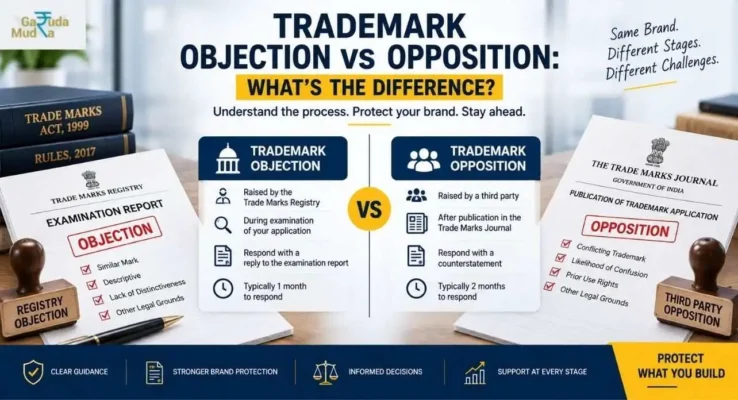
If you have applied for a trademark in India, you may come across terms such as trademark objection, trademark opposition, examination report, hearing, counterstatement and Trade Marks Journal. Although “objection” and “opposition” are often used interchangeably in everyday conversation, they are not the same thing — and understanding the difference matters because the person raising the issue, the stage of your application, the response process and the deadlines are all different.
Quick Answer: A trademark objection comes from the Trade Marks Registry as part of the examination of your application. A trademark opposition is a legal challenge filed by another person or entity against the registration of your trademark, after publication in the Trade Marks Journal.
On this page
- Quick Comparison Table
- What Is a Trademark Objection?
- Why Applications Get Objected To
- What Happens After an Objection?
- What Is a Trademark Opposition?
- What Happens After an Opposition?
- Objection vs Opposition — Key Differences
- Can a Mark Face Both?
- Documents Needed
- Opposition Fees
- What If You Ignore Either?
- How to Avoid Both
- Full 10-Stage Process Flow
- FAQs
Trademark Objection vs Opposition: Quick Comparison
| Point | Trademark Objection | Trademark Opposition |
|---|---|---|
| Who raises it? | Trade Marks Registry / Registrar | Third party |
| When does it happen? | During examination | After publication in Trade Marks Journal |
| Main document | Examination Report | Notice of Opposition |
| Applicant’s response | Reply to Examination Report | Counterstatement |
| Main purpose | Address concerns about registration | Prevent registration of the published trademark |
| Common grounds | Section 9, Section 11 & other examination issues | Prior trademark, similarity, prior rights & other legal grounds |
| Typical form | Examination process | TM-O proceedings |
| Can a hearing occur? | Yes | Yes |
| Can evidence be required? | Supporting documents may be submitted | Evidence and affidavits form part of the process |
| If ignored | Application may be treated as abandoned | Application may be treated as abandoned if counterstatement isn’t filed in time |
The official Trade Marks Rules, 2017 provide for examination objections under Rule 33 and opposition proceedings under Rules 42 onwards.
What Is a Trademark Objection in India?
A trademark objection occurs when the Trade Marks Registry identifies an issue with a trademark application during examination — including a search for earlier identical or deceptively similar trademarks, and consideration of other grounds under the Trade Marks Act. If the Registrar has an objection to accepting the application, it is communicated through an Examination Report, under Rule 33 of the Trade Marks Rules, 2017.
In simple terms, the Registry is saying: “We have identified an issue with this trademark application. Please explain why the application should proceed.” This is different from another business owner or trademark proprietor challenging your mark — that’s an opposition, covered further below.
Why Does a Trademark Application Get Objected To?
1. The Trademark Is Descriptive
A mark that directly describes the characteristics, quality, quantity, intended purpose or other features of goods/services may face an objection under Section 9.
2. Not Distinctive Enough
A trademark generally needs to distinguish one business’s goods or services from others — if it’s too generic, the Registry may object.
3. Similarity With an Earlier Mark
If the Registry identifies an earlier identical or deceptively similar mark for the same or similar goods/services, that’s a common ground.
4. Incorrect Classification
An inappropriate description of goods/services or the wrong class selection can create complications during examination.
5. Other Statutory Grounds
Objections can arise under various provisions of the Trade Marks Act, including absolute and relative grounds for refusal.
An objection should never simply be treated as a rejection — it’s an opportunity to respond. If you’d like to understand how to search for conflicting marks before you even file, see our guide on trademark search in India.
What Happens After a Trademark Objection?
Trademark Application Filed
↓
Examination by Trade Marks Registry
↓
Examination Report Issued / Objection Raised
↓
Applicant Submits Reply
↓
Acceptance / Hearing / Further Action
↓
Publication in Trade Marks Journal → Opposition Period → Registration
How much time do you have to reply? Under Rule 33(4) of the Trade Marks Rules, 2017, if the applicant does not respond to the examination report within one month from the date of receipt, the Registrar may treat the application as abandoned. If you receive an examination report, don’t wait until the last moment — a proper response may include legal arguments, an explanation of distinctiveness, evidence of use, invoices, advertising material, website information, sales records, affidavits and other supporting documents, depending on the specific objection.
Received an Examination Report?
Rule 33(4) gives you only one month to reply before the application risks being treated as abandoned. Talk to Garuda Mudra before that window closes.
What Is Trademark Opposition in India?
A trademark opposition is different — it generally occurs after the application has reached the publication stage. Once a trademark application is advertised in the Trade Marks Journal, a third party can oppose its registration within the prescribed period. Under the current Trade Marks Rules, 2017, a notice of opposition under Rule 42 must be filed in Form TM-O within four months from the date of publication in the Trade Marks Journal.
So the basic distinction is simple: Objection = Registry challenges the application during examination. Opposition = Third party challenges the application after publication.
Who Can File a Trademark Opposition?
A trademark opposition can be filed by a person or entity that believes the trademark should not be registered — for example, an existing business may oppose a new trademark because it believes the marks are identical or deceptively similar, registration could create confusion among consumers, the opponent has earlier trademark rights or prior use, or other applicable grounds under the Trade Marks Act are present. This is a third-party proceeding concerning registration, not simply another examination objection.
What Happens After a Trademark Opposition Is Filed?
Trademark Published in Journal
↓
Third Party Files Notice of Opposition
↓
Applicant Files Counterstatement
↓
Opponent’s Evidence → Applicant’s Evidence → Reply Evidence
↓
Hearing → Registrar’s Decision
↓
Registration or Refusal, Depending on Outcome
How long do you have to file a counterstatement? Under Rule 44 of the Trade Marks Rules, 2017, the applicant must file a counterstatement in Form TM-O within two months from receipt of the notice of opposition. If the counterstatement isn’t filed within the applicable period, the application can be treated as abandoned. An opposition should be treated as a formal legal proceeding, not a routine paperwork update.
What Is the Difference Between Trademark Objection and Opposition?
1. Who Raises the Issue?
Objection: raised by the Trade Marks Registry/Registrar during examination.
Opposition: brought by a third party — another business, trademark owner or other party with grounds to oppose.
2. At What Stage?
Objection: during the examination stage.
Opposition: after the application is advertised in the Trade Marks Journal, within a four-month window.
3. What Does the Applicant File?
For an objection: a Reply to Examination Report.
For an opposition: a Counterstatement. The two documents serve different purposes.
4. Who Are the Parties?
Objection: Applicant + Trade Marks Registry.
Opposition: Opponent + Applicant + Trade Marks Registry — making it more adversarial.
Trademark Objection vs Opposition: An Example
Suppose you launch a brand called “UrbanNest” for interior design services and file a trademark application. During examination, the Registry identifies an earlier similar mark and raises an objection — that’s a trademark objection. You respond, explaining why your mark should be accepted, and the application is accepted and published in the Trade Marks Journal. Now another business believes your mark is too similar to its own and files a formal challenge — that’s a trademark opposition. The same application can face both processes at different stages.
Can a Trademark Face Both Objection and Opposition?
Yes. A trademark may first receive an examination objection from the Registry, which the applicant responds to. If the application is accepted and published, a third party may subsequently oppose it. Objection and opposition are separate stages and separate legal processes — successfully responding to an examination objection does not automatically mean no one can oppose the trademark later. The application still has to pass through the publication and opposition stage.
Common Grounds for Trademark Objection
Depending on the facts, an examination objection may involve Section 9-related concerns (inherent registrability/distinctiveness and other absolute grounds), Section 11-related concerns (earlier trademarks and likelihood of confusion), similarity with earlier marks, unclear description of goods or services, classification issues, or other legal requirements identified during examination.
Common Grounds for Trademark Opposition
An opposition can be based on prior registered trademark rights, prior use of a trademark, similarity between trademarks or goods/services, likelihood of consumer confusion, lack of distinctiveness, descriptive nature, bad faith, or other applicable grounds under the Trade Marks Act. A notice of opposition is required to specify the grounds on which it is based, under Rule 43 of the Trade Marks Rules, 2017.
What Documents May Be Needed?
For an Objection Reply
Proof of use (invoices, bills, sales records, product packaging, website records, marketing/advertising material, business records), GST or business registration documents, financial records, brand evidence (screenshots, social media, brochures, catalogues), and an affidavit of use where appropriate. The evidence needed should be determined according to the actual objection and legal strategy.
For an Opposition
Opposition proceedings can involve substantially more documentation — earlier trademark registration certificates, application records, evidence of prior use, sales invoices, advertising expenditure, marketing campaigns, product packaging, website and consumer recognition evidence, affidavits and other supporting business records. The Rules specifically provide for evidence by affidavit during opposition proceedings.
Trademark Opposition Fees in India
The official IP India fee schedule currently lists TM-O for a notice of opposition under Section 21 and certain related proceedings. The current listed e-filing fee for a notice of opposition is ₹2,700 per class, while physical filing is listed at ₹3,000 per class. However, official fees can change through amendments or notifications — always verify the applicable fee on the official IP India portal before filing.
What Happens If You Ignore an Objection or Opposition?
Ignoring an Objection
Under Rule 33(4), if you don’t respond within one month of receiving the examination report, the Registrar may treat the application as abandoned — meaning delay in registration, additional professional costs, and risk of losing the application altogether.
Ignoring an Opposition
This can be even more serious. If the required counterstatement isn’t filed within the prescribed period, the application can be treated as abandoned. Publication does not equal registration — don’t assume your trademark is safe simply because it has been published.
It’s also worth clarifying two common misunderstandings: an objection is not the same as a rejection — the applicant normally gets an opportunity to respond — and an opposition is not the same as a rejection either. The Registrar ultimately considers the matter and decides whether registration should be permitted, subject to applicable law and procedure.
Can You Handle These Yourself?
Technically, yes — but the quality of the response matters significantly. For an objection, a strong reply addresses the specific legal grounds raised (visual, phonetic and conceptual differences, goods and services, trade channels, target consumers, actual use) rather than simply asserting “our trademark is unique.” For an opposition, the process is generally more complex — involving a counterstatement, legal grounds, evidence, affidavits, procedural deadlines, hearings and written arguments — so for an important commercial brand, professional legal advice is worth considering rather than treating it like a routine application update.
How to Avoid Trademark Objection and Opposition
- Conduct a Proper Trademark SearchSearch existing registered and pending trademarks — not just exact matches, but similar spellings, pronunciations, word combinations, logos and related goods/services. Our guide on how to check trademark availability in India walks through this.
- Choose a Distinctive Brand NameA unique, distinctive mark generally provides a stronger foundation than a highly descriptive or generic expression.
- Select the Correct Trademark ClassYour protection depends heavily on the goods and services covered. See our explainer on trademark class search in India and Trademark Class 1 explained.
- Check Similar BusinessesDon’t limit your research to the exact product you sell — consider how similar marks are used in related markets.
- Keep Evidence of Brand UseMaintain invoices, advertising records, website records, packaging, product photographs, marketing campaigns and sales records — useful for establishing prior use or acquired distinctiveness later.
Trademark Objection vs Opposition: Which Is More Serious?
There’s no universal answer. An examination objection may be relatively straightforward when the issue can be addressed through a clear legal response and supporting evidence. An opposition can become more complex because another party is actively challenging registration. Seriousness depends on the strength of the opposing party’s rights, similarity between marks and goods/services, evidence of prior use, the strength of your own evidence, the grounds raised, and the commercial importance of the brand. The right question isn’t “which is worse” — it’s “what is the specific legal issue, and how strong is my evidence?”
Trademark Objection vs Opposition: Simple Flow for Indian Businesses
1. Application→
2. Examination→
3. Objection, If Any→
4. Reply→
5. Hearing, If Required→
6. Acceptance→
7. Trade Marks Journal→
8. Opposition Period→
9. Opposition Proceedings, If Filed→
10. Registration
IP India’s current workflow reflects this overall sequence — from application and examination through publication, opposition and registration. To understand the difference between the search you do before filing and the registration process itself, see our guide on trademark search vs trademark registration.
Frequently Asked Questions About Trademark Objection vs Opposition
What is the difference between trademark objection and opposition?
A trademark objection is raised by the Trade Marks Registry during examination of a trademark application. A trademark opposition is filed by a third party against registration after the application has been advertised in the Trade Marks Journal.
Who can file a trademark opposition in India?
A person or entity with applicable grounds can file an opposition against a trademark application. The opposition must follow the prescribed procedure and requirements under the Trade Marks Act and Rules.
How long do I have to oppose a trademark in India?
Under the current Trade Marks Rules, 2017, a notice of opposition is filed within four months from publication of the relevant trademark application in the Trade Marks Journal.
How long do I have to reply to a trademark objection?
Under Rule 33, the applicant has one month from receipt of the examination report to respond. If the applicant does not respond within that period, the Registrar may treat the application as abandoned.
What is TM-O used for?
TM-O is used for several trademark proceedings, including a notice of opposition under Section 21 and certain related proceedings. The current IP India fee schedule identifies TM-O as the applicable form for notice of opposition.
Can a trademark be opposed after examination?
Yes. A trademark can clear examination and still face opposition after it is published in the Trade Marks Journal.
Can a trademark objection be removed?
In many cases, an applicant can respond to the examination objections with appropriate legal arguments and supporting evidence. Whether the objection is waived depends on the facts and the Registrar’s consideration.
Does a trademark objection mean rejection?
No. An objection is not automatically a final rejection. The applicant normally gets an opportunity to respond.
Does trademark publication mean the trademark is registered?
No. Publication is a stage in the registration process. A third party may oppose the application during the applicable opposition period.
What happens if I do not respond to a trademark opposition?
Failure to file the required counterstatement within the prescribed period can result in the application being treated as abandoned under the applicable procedure.
Can the same trademark face both objection and opposition?
Yes. A trademark can receive an examination objection from the Registry and later face opposition from a third party after publication.
Should I hire a trademark professional for an objection or opposition?
For simple matters, an applicant may be able to manage certain procedural steps. However, where the matter involves similarity, prior rights, evidence, hearings or a commercially important brand, professional trademark assistance can help assess the legal position and prepare the appropriate response.
Final Takeaway: Objection vs Opposition
The easiest way to remember the difference: Trademark Objection = Registry raises an issue during examination. Trademark Opposition = Third party challenges registration after publication. An objection generally requires a reply to the Examination Report; an opposition generally requires a counterstatement and potentially evidence and hearing proceedings. For businesses in India, both stages should be taken seriously because delays or missed deadlines can affect the trademark application.
If you receive an examination report or opposition notice, first identify what stage your application is at, what grounds have been raised, and what deadline applies. Don’t assume an objection means rejection, and don’t assume publication means registration. Proper trademark searching before filing, timely responses, accurate documentation and professional guidance where necessary can significantly reduce avoidable trademark complications.
Need Help With a Trademark Objection or Opposition?
If your trademark application has received an examination objection, or your brand is facing a trademark opposition in India, the next step is to review the specific grounds and prepare an appropriate response. Garuda Mudra can help with trademark search, application filing, examination objection replies, hearing support, opposition and counterstatement preparation, evidence preparation and ongoing trademark monitoring.
Important: Trademark procedures and official fees can change through amendments, notifications and Registry practice. The Trade Marks Act, 1999, Trade Marks Rules, 2017 and applicable official notifications should be checked for the current position. This article is for general educational information for businesses in India and is not a substitute for legal advice.
2 thoughts on “Trademark Objection vs Trademark Opposition: What’s the Difference?”