
Need help? Call us:
+91-9711029902
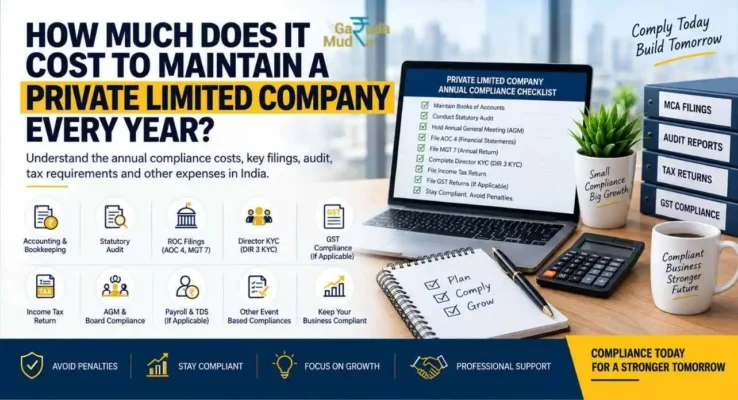
Starting a Private Limited Company in India is only the beginning. Once incorporated, it carries ongoing legal, accounting, taxation and regulatory responsibilities — even when the company has low turnover, no employees or limited business activity. One of the most common questions new founders ask is: “How much does it cost to maintain a Private Limited Company every year in India?”
Quick Answer: There is no single fixed amount, because annual cost depends on the company’s turnover, number of transactions, GST registration, number of directors, accounting requirements, audit complexity, payroll, location and applicable professional fees.
For a small Private Limited Company with relatively simple operations, annual compliance and accounting costs can often fall in the ₹25,000 to ₹60,000 range, while companies with more transactions, GST, payroll or multiple directors may spend ₹50,000 to ₹1,00,000+ per year. These are indicative professional-market ranges, not government-prescribed fees.
₹25K–₹60KBasic company, simple operations
₹50K–₹1L+Active company: GST, employees, more transactions
₹1L+Complex: investors, multiple directors, loans
On this page
- Quick Cost Breakdown Table
- What “Maintaining” a Company Means
- 10 Cost Components Explained
- Basic vs Active Company: 4 Examples
- What’s in a Compliance Package?
- Government Fees vs Professional Fees
- Why Two Companies Pay Differently
- No Business — Still Costs?
- What If You Skip Compliance?
- How to Reduce Costs
- Compliance Calendar
- FAQs
What Is the Annual Cost of Maintaining a Private Limited Company?
For a small and relatively straightforward Private Limited Company in India, a practical annual budget can look like this:
| Expense | Indicative Annual Cost |
|---|---|
| Accounting and bookkeeping | ₹10,000 – ₹30,000+ |
| Statutory audit | ₹8,000 – ₹25,000+ |
| ROC and annual compliance | ₹5,000 – ₹20,000+ |
| AGM and documentation | Often included in package |
| Income tax return & tax support | ₹5,000 – ₹15,000+ |
| Director KYC & routine MCA work | ₹0 – ₹5,000+ |
| GST compliance, if applicable | ₹6,000 – ₹30,000+ |
| Payroll and TDS, if applicable | Additional |
| Other event-based compliance | Additional |
These figures should be treated as planning estimates rather than fixed market prices — government filing fees and professional charges are separate components of the total cost.
What Does “Maintaining a Private Limited Company” Actually Mean?
Annual maintenance is not simply renewing the company’s registration. A Private Limited Company is expected to maintain proper books, prepare financial statements, conduct applicable meetings, complete statutory audit requirements, file documents with the Ministry of Corporate Affairs and complete other applicable tax and regulatory compliances. The Companies Act, 2013 provides the framework for several of these obligations — for example, requiring companies other than One Person Companies to hold an AGM every year, generally within six months from the close of the financial year (the first AGM has a different nine-month period).
Major Components of Private Limited Company Annual Compliance Cost
1
Accounting and Bookkeeping ₹10K–₹30K+
Before annual filings can be completed, books of accounts need to be properly maintained — sales, purchases, expenses, bank transactions, receivables, payables, loans, director transactions, investments and fixed assets. Cost depends heavily on transaction volume: a company with 20 transactions/month is very different from one processing 500/month. Our accounting and bookkeeping services can help scope this accurately for your business.
2
Statutory Audit ₹8K–₹25K+
A Private Limited Company generally has statutory audit requirements under the Companies Act, subject to applicable provisions and exemptions. The Act provides for appointment of an auditor at the first AGM, generally holding office until the conclusion of the sixth AGM. Cost depends on turnover, number of transactions, business model, number of locations, inventory, loans, related-party transactions and the quality of your accounting records — this is not a government fixed fee.
3
ROC Annual Filing ₹5K–₹20K+
One of the most important parts of annual compliance is filing required documents with the Registrar of Companies via the MCA system. AOC 4 is used for filing financial statements; MGT 7 is the annual return form for applicable companies, while eligible OPCs and small companies may use MGT 7A instead.
Is there a fixed MCA fee? No — MCA fees depend on authorised share capital, type of company, the specific form being filed, and other applicable factors. Your total professional bill typically covers: government fee + professional fee + accounting work + audit + documentation + applicable tax compliance.
4
AGM and Corporate Documentation
Section 96 of the Companies Act, 2013 requires every company other than an OPC to hold an AGM each year — generally within six months from the end of the financial year (nine months for the first AGM). This process involves notice preparation, financial statements, Board report, auditor report, minutes, resolutions and statutory registers. If charged separately from your compliance package, this can add to the total.
5
Director KYC ₹0–₹5K+
Directors holding a DIN must complete the applicable annual KYC requirements, generally by 30 September. Filing on time generally has no government fee — but MCA’s DIR-3-KYC instruction kit states that certain delayed KYC filings can attract a ₹5,000 fee. Timely compliance is a simple, direct way to avoid unnecessary cost.
6
Income Tax Return & Tax Compliance ₹5K–₹15K+
The company needs to prepare its financial information and complete its applicable income tax return and related compliance. The actual cost depends on turnover, profit/loss, deductions, depreciation, loans, related-party transactions and any tax audit or TDS requirements. This is often bundled with accounting and ROC services.
7
GST Compliance ₹6K–₹30K+
GST isn’t automatic just because a company is a Private Limited Company — but if registered, this can include GSTR-1, GSTR-3B, reconciliation, ITC reconciliation, notices and annual return work where applicable. A small business with low transaction volume may spend roughly ₹500 to ₹2,500+ per month, adding up to ₹6,000–₹30,000+ annually. See our GST return filing services.
8
TDS Compliance
If the company has employees, professional payments, rent or other transactions requiring tax deduction at source, this involves TDS calculation, payment, return filing, certificates, reconciliation and correction statements where necessary.
9
Payroll Compliance
If the company has employees, payroll adds salary calculation, TDS on salary, PF, ESIC, professional tax, salary slips and labour-law compliance — depending on employee count, salary structure, state and applicable registrations. Our PF return filing services cover part of this workflow.
10
Secretarial & Event-Based MCA Compliance
Some companies require more than basic annual filing — changes in directors, share transfers, increase in share capital, allotment of shares, registered office changes, creation/satisfaction of charges, related-party transactions or beneficial ownership requirements. These are generally event-based: a company with no changes during the year will typically have a lower annual maintenance cost than one that frequently changes directors, capital structure or business arrangements.
Not Sure Which of These Apply to Your Company?
Every business’s compliance mix is different. Get a straight answer on what your company actually needs — and what it should cost — before you commit to a package.
Private Limited Company Annual Compliance Cost: Basic vs Active Company
The easiest way to understand the cost is to compare different company profiles:
Example 1: Small Private Limited Company
₹25,000 – ₹45,000 / year- 2 directors
- Low transaction volume
- No employees
- No GST requirement
- No major corporate changes
- Simple business model
Example 2: Small Business With GST
₹35,000 – ₹65,000+ / year- 2 directors
- GST registered
- Regular sales
- Monthly GST compliance
- Low to moderate transactions
- No major corporate changes
Example 3: Company With Employees
₹50,000 – ₹1,00,000+ / year- 3 directors
- GST registration
- Employees & payroll
- TDS compliance
- Regular accounting
- Annual audit & ROC compliance
Example 4: Growing Company
₹1,00,000+ / year- High transaction volume
- Multiple employees
- GST & TDS
- Multiple bank accounts
- Loans, investors, share transfers
- Related-party transactions
What Is Included in a Typical Annual Compliance Package?
When comparing service providers, don’t compare prices based only on the headline number — ask what is actually included.
Accounting
Bookkeeping, ledger maintenance, bank reconciliation, financial statements.
Audit
Statutory audit coordination, audit report, auditor documentation.
MCA Compliance
AOC 4, MGT 7 or MGT 7A where applicable, AGM documentation, Board documentation, Director KYC.
Tax
Income tax return, TDS compliance, GST compliance if included.
A cheaper package may exclude several of these services — always compare scope, not just price.
Government Fees vs Professional Fees
This is one of the most important concepts when calculating the cost of maintaining a Private Limited Company. Your annual expense broadly divides into two categories:
Government Fees
Fees payable to the relevant government authority for specific filings or services. For MCA filings, these are governed by a prescribed fee schedule and vary depending on the filing and company details.
Professional Fees
Charges paid to professionals or service providers for accounting, audit, tax filing, ROC filing, company secretarial work, GST filing, payroll and compliance advisory.
A company may pay very little in direct government fees while still having a significant professional compliance cost — the two should never be confused.
Why Do Two Companies Pay Different Annual Compliance Costs?
Two Private Limited Companies incorporated on the same day can have completely different annual maintenance expenses. The biggest factors:
Turnover
Higher turnover usually means more accounting and tax work.
Number of Transactions
More invoices and bank transactions mean more bookkeeping and reconciliation.
GST Registration
Adds recurring filing and reconciliation work.
Number of Employees
Introduces payroll, TDS, PF, ESIC and other obligations.
Number of Directors
Certain director-related compliance can increase with more directors.
Business Structure
A simple consultancy is easier to maintain than one with inventory, exports, loans and multiple locations.
Corporate Changes
Changes in directors, shareholders, registered office or capital structure require additional filings.
Accounting Quality
Poorly maintained accounts can significantly increase professional work at year end.
Tax Complexity
Complicated tax positions require additional professional support.
Does a Company With No Business Still Have Annual Compliance Costs?
Yes. This is one of the biggest misconceptions among new founders. A company does not automatically stop having compliance responsibilities because it has no sales, no customers, no employees, no revenue or no profit. A dormant or inactive business may have different compliance considerations, but simply having no transactions does not automatically eliminate all corporate obligations — annual filings, financial statements, applicable audit requirements and AGM requirements may still need to be considered. Don’t assume “we did not do business this year, so we do not need to file anything.”
What Happens If You Do Not Maintain Annual Compliance?
Ignoring annual compliance can create additional costs and complications, including additional government fees, penalties, interest in applicable tax matters, director compliance issues, MCA notices, difficulty obtaining updated company records, problems during due diligence or with investors, and compliance backlogs. The cost of fixing several years of missed compliance can be significantly higher than maintaining the company correctly every year.
How to Reduce Private Limited Company Annual Compliance Cost
You should not try to reduce costs by skipping mandatory compliance — instead, reduce unnecessary work:
- Maintain Accounts Throughout the YearDon’t wait until March or September to organise your books.
- Keep Business and Personal Transactions SeparateUse company bank accounts properly and avoid unnecessary personal transactions.
- Maintain Invoices and Supporting DocumentsGood documentation reduces year-end accounting work.
- Reconcile RegularlyRegular bank, GST and accounting reconciliation helps identify problems early.
- Track Compliance DeadlinesMaintain a calendar for GST, TDS, MCA, income tax, director KYC and AGM.
- Choose an Integrated Compliance ProviderSeparate providers for accounting, GST, tax and MCA can create duplication — an integrated service can make coordination easier.
- Ask for a Transparent Annual PackageBefore engaging a professional, ask exactly what’s included in the annual fee to prevent unexpected charges.
Private Limited Company Annual Compliance Calendar
| Compliance | Typical Requirement |
|---|---|
| Accounting | Throughout the year |
| GST | Monthly/quarterly where applicable |
| TDS | Periodic, where applicable |
| Director KYC | Generally by 30 September |
| AGM | Generally within 6 months of FY end |
| Financial statements filing | Generally after AGM, within prescribed period |
| Annual return | Generally after AGM, within prescribed period |
| Income tax return | Applicable annual deadline |
| Other MCA forms | Event-based |
The exact due date can vary depending on the company’s circumstances, applicable law and any extensions or changes notified by authorities. For more on the underlying filings themselves, see our detailed guide on small business compliance in India.
Frequently Asked Questions
How much does it cost to maintain a Private Limited Company in India every year?
A small Private Limited Company with simple operations may spend approximately ₹25,000 to ₹60,000 per year on accounting, audit, ROC and related professional compliance. Companies with GST, employees and more complex transactions may spend ₹50,000 to ₹1,00,000 or more. These are indicative market ranges, not fixed government charges.
Is annual compliance mandatory for a Private Limited Company?
Yes. Private Limited Companies generally have ongoing corporate and financial compliance responsibilities even when business activity is low.
What are the main annual ROC filings for a Private Limited Company?
Common annual filings include AOC 4 for financial statements and MGT 7 or MGT 7A, as applicable, for the annual return.
Does a Private Limited Company need an audit every year?
Companies generally have statutory audit requirements under the Companies Act, subject to the applicable provisions. The cost depends on the company’s size and complexity.
How much does a Private Limited Company auditor charge?
There is no single government-prescribed annual audit fee applicable to every company. Professional fees can vary significantly — for a small company, an indicative range may be around ₹8,000 to ₹25,000+, depending on the scope and complexity.
Does a company with no turnover need annual compliance?
Generally, lack of turnover does not automatically remove corporate compliance obligations. The company should assess its applicable annual filings, financial statements, audit and other requirements.
Is GST compliance included in Private Limited Company annual compliance?
Not necessarily. GST compliance is generally an additional component unless it is specifically included in the service package.
Is director KYC mandatory every year?
Applicable DIN holders have annual KYC requirements. The standard annual deadline is generally 30 September.
What happens if DIR 3 KYC is filed late?
Delayed KYC can attract an additional fee. The MCA instruction kit currently specifies ₹5,000 for certain delayed KYC filings.
Can I maintain a Private Limited Company myself?
Some compliance tasks can be managed internally, particularly if the founders have appropriate accounting and compliance knowledge. However, statutory audit and certain professional activities require qualified professionals where applicable.
Is ROC filing fee the same for every company?
No. MCA filing fees can depend on factors including the applicable form and company details such as authorised share capital.
What is cheaper: Private Limited Company or LLP?
The answer depends on the business structure, number of partners/directors, turnover, tax position and compliance requirements. A comparison should consider both legal requirements and professional costs rather than only incorporation fees.
Final Takeaway
The cost of maintaining a Private Limited Company in India depends on the company’s actual operations. For a small company with limited transactions, a reasonable planning budget is around ₹25,000 to ₹60,000 per year. For a more active company with GST, employees, payroll and regular transactions, expect ₹50,000 to ₹1,00,000+ per year. For companies with investors, multiple directors, complex transactions or loans, ₹1,00,000+ per year may be required.
But the cheapest compliance package is not necessarily the best option. A proper annual compliance plan should cover the company’s actual requirements — accounting, audit, MCA filings, tax compliance, director KYC and any applicable GST, payroll or event-based compliances. Calculate your company’s annual compliance cost based on what your business actually needs, rather than choosing a package based only on the lowest advertised price.
Need Help With Private Limited Company Annual Compliance?
Managing accounting, ROC filings, annual returns, statutory audit, director KYC and tax compliance can become difficult when founders are focused on running the business. Garuda Mudra can help with the full range — annual compliance, ROC filing, AOC 4, MGT 7/7A, AGM compliance, director KYC, accounting, income tax, GST and statutory audit coordination — so your company stays on time and penalty-free.
Important: Government fees, filing requirements and compliance rules can change through amendments, notifications and MCA updates. Always verify the current requirements applicable to your company before filing. This article is for general educational purposes and should not be treated as legal, tax or professional advice.
One thought on “How Much Does It Cost to Maintain a Private Limited Company Every Year?”