
Need help? Call us:
+91-9711029902
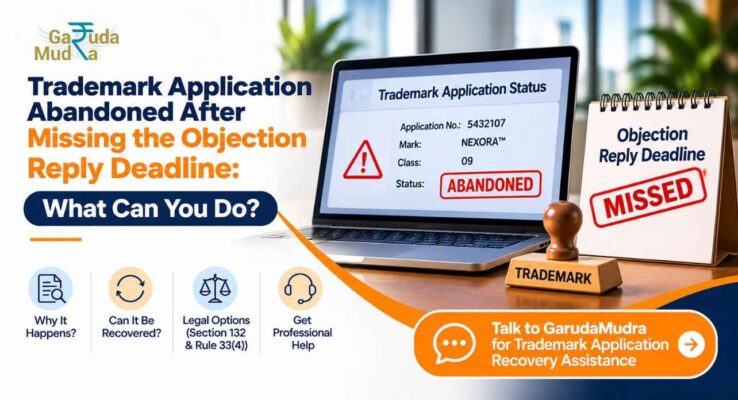
You applied for trademark registration in India, received an examination report from the Trade Marks Registry, and planned to respond to the objections — but something went wrong. Perhaps you missed the reply deadline, your trademark consultant didn’t inform you about the report, an email went unnoticed, or you assumed the application was still under examination. When you finally check the status, you see an unexpected update: “Abandoned.” You may have already invested in branding, packaging, advertising and marketing — and now you’re worried your brand name may no longer be protected. The first question is: can an abandoned trademark application be restored in India?
Quick Answer: An abandoned trademark application may be capable of recovery in certain circumstances, but restoration is not automatic. Under Rule 33(4) of the Trade Marks Rules, 2017, if an applicant fails to respond to the examination report within one month from receipt, the Registrar may treat the application as abandoned. Section 132 of the Trade Marks Act, 1999 deals with abandonment where the applicant defaults in prosecuting the application and the Registrar follows the prescribed notice and opportunity procedure. Indian law provides procedural remedies — review of eligible Registrar decisions and judicial remedies in appropriate cases — but there is no universal automatic restoration facility that guarantees revival of every abandoned application.
If your application is marked abandoned, the first steps should be:
- Check the official trademark application status
- Download the examination report and correspondence
- Identify the date the examination report was received
- Check whether a formal abandonment order has been issued
- Examine whether the required notice and procedure were followed
- Assess whether review, appeal or a writ remedy may be available
- Consider whether filing a fresh application is more appropriate
Don’t immediately file another trademark application or assume your old application can be revived — first obtain a legal assessment of the existing record.
On this page
- What Does “Abandoned” Mean?
- Why Applications Get Abandoned
- The One-Month Deadline
- Section 132 Explained
- What Happens When Abandoned
- 3 Recovery Routes
- Recent Court Decisions
- Immediate Steps
- Documents Required
- Filing a Fresh Application
- Abandoned vs Refused vs Withdrawn
- If Your Consultant Missed It
- Cost to Recover
- Preventing Abandonment
- FAQs
What Does “Trademark Application Abandoned” Mean?
A trademark application is described as abandoned when the applicant has failed to take a required step in the registration process and the Registry has treated the application as abandoned under the applicable provisions. It means the application is no longer progressing through the normal registration process. For example: a business applies, the Registry examines it, an examination report raises objections under Section 9 or Section 11, the applicant doesn’t respond in time, and the status is updated to abandoned — the applicant may lose the opportunity to continue prosecuting the original application through ordinary examination. An abandoned application is not the same as a refused application, a withdrawn application or an expired registered trademark.
Just Discovered Your Application Shows “Abandoned”?
Don’t assume your brand protection options are over — and don’t rush into a new application either. A quick review of the Registry record comes first.
Why Does the Trademark Registry Abandon an Application?
1
Failure to Reply to the Examination Report
One of the most common situations. If the applicant fails to respond within one month from receipt of the examination report, Rule 33(4) allows the Registrar to treat the application as abandoned.
2
Failure to Attend a Scheduled Hearing
An applicant may submit a reply yet still face objections, and the matter may proceed to a show cause hearing. Under Rule 33(7), if the applicant fails to appear and hasn’t submitted a reply to the office objection, the Registrar may treat the application as abandoned — the procedural record should be reviewed before concluding that abandonment was proper. See our guide on trademark hearing in India.
3
Failure to Remedy Application Deficiencies
Rule 31 deals with deficiencies in applications. If the Registry sends a notice requiring correction and the applicant fails to remedy it within one month, the application may be treated as abandoned.
4
Failure to Act During Opposition Proceedings
Abandonment can occur at later stages too — for example, under Rule 46, if the applicant fails to take the required action regarding evidence in support of the application during opposition proceedings, it may be deemed abandoned. See our guide on trademark opposition in India.
It’s important to identify the exact reason for abandonment rather than assuming every abandoned application has the same remedy.
What Is the Deadline for Replying to a Trademark Examination Report?
Under Rule 33(4), the applicant has one month from the date of receipt of the examination report to respond; if not, the Registrar may treat the application as abandoned. For background on how a proper response is structured, see our guide on trademark objection reply in India.
| Particular | Example |
|---|---|
| Examination report received | 10 October 2026 |
| Applicable response period | One month |
| Normal response deadline | 10 November 2026 |
| No response submitted | Registry may consider abandonment |
| Application status updated | Abandoned, depending on Registry action |
This is illustrative — the actual deadline should be calculated from the legally relevant date of receipt and the applicable procedural record. Can you ignore an examination report? No — even if an objection seems incorrect (say, based on a similar existing mark, or on descriptiveness), the applicant should respond within the prescribed period with arguments on distinguishability, distinctiveness and supporting evidence of use.
Missed the One-Month Reply Deadline?
Whether the application is already marked abandoned or you’re right at the edge of the deadline, the next 24 hours of decisions matter. Talk to us before taking any step.
What Is Section 132 of the Trade Marks Act, 1999?
Section 132 deals with abandonment of trademark applications. It provides that where the Registrar considers an applicant to be in default in prosecuting an application, the Registrar may issue a notice requiring the applicant to remedy the default within the specified time. After giving the applicant an opportunity of being heard (if desired), the Registrar may treat the application as abandoned if the default isn’t remedied in time. In simple terms, it addresses situations where an applicant fails to take a required step in registration.
Why it matters when reviewing an abandonment order: understand what default was identified, whether a notice was issued, whether the applicant was given the opportunity required by law, whether the default was capable of being remedied, whether the required procedure was followed, and whether the application was correctly marked abandoned. A proper review of Registry correspondence can reveal whether there’s a genuine procedural issue worth pursuing.
What Happens When a Trademark Application Is Abandoned?
Once abandoned, the normal registration process doesn’t continue as if the application were pending. Practical consequences may include: the original application stops progressing through examination; the applicant may lose the original opportunity to secure registration through it; the original filing date may not be available to a fresh application; a competitor may file a similar application; the applicant may need to evaluate review, appeal or judicial remedies; and a fresh application may become necessary if recovery isn’t available.
One important point: an abandoned application does not automatically mean the business has lost every possible right in its brand. Depending on the facts, prior use and other rights may still be relevant — Section 27(2) preserves the right to bring a passing-off action, subject to legal requirements. But prior-use rights and registered trademark protection are not the same thing.
Can You Recover an Abandoned Trademark Application in India?
There’s no general rule that every abandoned application can be restored simply by submitting a late reply. The possible approaches include reviewing the abandonment order and Registry records, assessing whether the abandonment procedure was legally followed, considering review where statutory requirements are met, considering an appeal or writ remedy where legally available, and evaluating whether a fresh application is the more practical option — decided only after reviewing the complete file.
Route 1 — Review of the Registrar’s Decision
Rule 119 provides for an application for review of an eligible decision under Section 127(c), made in Form TM-M, generally within one month from the date of the decision (the Registrar may allow a further period of up to one month on request). It must include a statement of grounds, and the Registrar may grant or reject after hearing the parties. Review isn’t automatic for every missed deadline — you must show the decision can properly be reviewed and that legally sustainable grounds exist. “The applicant forgot to reply” alone may not suffice.
Route 2 — Appeal
Depending on the order, an appeal may lie under Section 91 before the appropriate High Court, with a general limitation of three months from the date the order is communicated, subject to applicable provisions. Check forum, maintainability and limitation against the actual order. An appeal is a formal challenge to a Registrar’s decision, requiring proper legal grounds — it’s not a routine late reply.
Route 3 — Writ Petition Before the High Court
In appropriate cases, constitutional writ jurisdiction may be considered — for example where the applicant wasn’t given required notice, abandonment was passed without following prescribed procedure, the Registry failed to consider a timely response, a demonstrable administrative error occurred, there was a serious breach of natural justice, or the Registry acted outside its authority. It’s not a guaranteed method of reviving every abandoned application; the High Court examines facts, grounds, delay and alternative remedies.
Time Is the Biggest Risk
Review has a one-month window (plus up to one more on request), appeals typically three months, and writs are assessed on delay. The sooner the record is reviewed, the more routes may remain open — older cases aren’t automatically impossible, but are harder.
Not Sure Whether Review, Appeal, Writ or a Fresh Filing Is Right?
Each route has a different deadline, forum and cost. The right choice depends entirely on your Registry record — get it reviewed before you commit to any path.
Recent Court Decisions: Why the Abandonment Record Matters
Mars Incorporated v. Registrar of Trade Marks & Others (2025)
The Delhi High Court examined issues arising from trademark applications being marked abandoned after earlier public notices and a subsequent restoration process — including the Registry’s treatment of an application despite the applicant submitting a grievance and seeking reconsideration. It illustrates why applicants should preserve filing records, grievances and Registry correspondence rather than relying only on the online status.
Ashiana Ispat Limited v. Kamdhenu Limited & Others (2025)
The Delhi High Court discussed the Rule 33 examination procedure, including the requirement to respond to the First Examination Report within one month, and the Registry’s authority to treat an application as abandoned when prescribed requirements aren’t met — underlining the importance of the response timeline.
These decisions should not be read as creating a universal right to restore every abandoned application — the facts and procedural history of each matter are important.
What Should You Do Immediately After Discovering an Abandoned Application?
- Check the Official Trademark StatusVisit the IP India Trademark eRegister, search by application number, and check status, applicant, mark, class, examination report details, correspondence history and abandonment date — not just a third-party screenshot. Our guide on trademark search in India covers the search side.
- Download the Examination ReportIdentify the objections raised under Section 9, Section 11 or other provisions, and understand what response was originally required.
- Check the Correspondence HistoryWas the report communicated? Did the applicant or agent receive it? Was any reminder issued? Was a response submitted and acknowledged? Was a hearing scheduled? Was an abandonment order passed?
- Identify the Actual Abandonment ReasonNo reply filed? Deficiency uncorrected? Hearing missed? Abandonment during opposition? Each needs a different assessment.
- Check the Date of the Abandonment OrderCritical for limitation periods — don’t assume the clock starts when you discovered the status; the relevant date may be the date of the decision or its communication, depending on the remedy.
- Get the File ReviewedA trademark professional should examine the record before recommending review, appeal, writ or a fresh application.
Need Help Pulling and Reading Your Registry Records?
Status history, examination report, correspondence and the abandonment order itself — we can help you assemble and interpret the full file.
Documents Required to Assess an Abandoned Trademark Application
| Document | Purpose |
|---|---|
| Trademark application number | Identifies the original application |
| Application acknowledgement | Confirms the original filing |
| Examination report | Identifies the objections |
| Examination report reply, if submitted | Establishes whether a response was filed |
| Filing acknowledgement | Helps prove submission and date |
| Registry correspondence | Shows notices and communications |
| Abandonment order | Establishes the decision and stated reason |
| Trademark status history | Shows the application timeline |
| Power of Attorney / authorisation | Helps verify agent representation |
| Proof of use | Supports commercial or prior-use arguments |
| Business registration documents | Helps verify the applicant’s identity |
| Relevant email communication | May help establish communication or administrative issues |
If the applicant already submitted a response but the status still shows abandoned, the filing acknowledgement and Registry record are particularly important.
Can You File a Fresh Trademark Application Instead?
Yes — but it shouldn’t be the automatic first decision. A fresh application does not recover the original filing date; it receives a new one. Before refiling, examine whether the original abandonment can be challenged, whether the original filing date has commercial or legal value, whether another business has filed a similar mark meanwhile, whether the original objections can be addressed, whether the mark is still available, whether your goods/services have changed, and whether a new application could face the same objections. See our guides on how to check trademark availability and trademark registration in India.
Example: A startup applied in 2024, never answered the examination report, and was marked abandoned in 2025; it discovers the issue in November 2026. A professional review might find no practical basis to challenge the old order, review/appeal limitation has passed, the brand is still available, and no significant third-party application has appeared — in which case a fresh application may be worth considering. But if the application was marked abandoned despite a timely response that the Registry ignored, challenging the earlier decision may deserve priority.
Abandoned vs Refused vs Withdrawn Trademark Applications
| Basis | Abandoned | Refused |
|---|---|---|
| Meaning | Treated as abandoned due to procedural default or other applicable reason | Registrar has refused the application |
| Common reason | Missed deadline, failure to take required action | Legal objections not overcome |
| Examination reply | May not have been filed or action not completed | May have been considered and rejected |
| Legal assessment | Focuses on default and the abandonment procedure | Focuses on the refusal decision and legal grounds |
| Possible remedies | Review, appeal or writ where applicable | Appeal or other remedy where available |
| Fresh application | May be considered after assessing availability and rights | May be considered after addressing refusal grounds |
A withdrawn application is one the applicant voluntarily chose to discontinue; an abandoned one was treated as discontinued because of a default. For an abandoned application, examine whether the default and abandonment procedure were properly handled; for a withdrawn one, examine the withdrawal record and its consequences. For a related situation where an earlier mark cited against you is in such a status, see our guide on trademark objection vs opposition.
Can you file a late objection reply? A late response shouldn’t be assumed to revive an abandoned application — Rule 33(4) gives the Registrar power to treat the application as abandoned after one month. If the application hasn’t yet been formally abandoned, immediately examine the status and record to see whether any action remains possible; if abandonment has already occurred, assess the review or challenge route rather than simply uploading a late reply and assuming it will be accepted.
What If Your Trademark Consultant Missed the Reply Deadline?
This is particularly frustrating: you appointed a consultant or agent and assumed they’d monitor the application, only to discover the examination report was received, no response was filed, the application was marked abandoned, and you weren’t informed. Collect the engagement documents, emails, WhatsApp messages, the examination report, filing acknowledgements, agent correspondence and the abandonment order — these may help establish what happened and whether there are grounds to challenge the decision. However, a consultant’s failure doesn’t automatically guarantee restoration; the available legal remedy must be assessed separately from any contractual or professional-responsibility issue. If you’re now looking for a replacement, see our guides on trademark registration consultants in Delhi and hiring a trademark consultant in Delhi.
Your Previous Consultant Never Told You About the Examination Report?
Your emails, acknowledgements and correspondence can be central to assessing recovery options. Don’t delete anything — send it across for review.
Can an Application Be Restored After Several Months or Years?
There’s no universal restoration period — the available route depends on the legal nature of the decision. Review: one month from the decision under Rule 119, with a possible further month on request. Appeal: a general three-month limitation under Section 91. Writ petition: the High Court examines facts, delay, alternative remedies and grounds — with no general guarantee that a delayed petition will be entertained. If months or years have passed the case may be more difficult, though not automatically impossible — which is why professional review is especially important.
How Much Does It Cost to Recover an Abandoned Application?
There’s no single fixed government fee for recovering every abandoned application — cost depends on the legal route and work involved.
| Possible Work | Cost Consideration |
|---|---|
| Status and file review | Professional review charges |
| Examination report analysis | Professional drafting and assessment |
| Registry correspondence review | Depends on the number of documents |
| Review application | Applicable Form TM-M government fee plus professional charges |
| Appeal | Court filing fees and legal representation |
| Writ petition | Court expenses and legal representation |
| Fresh trademark application | Applicable new application fee plus professional charges |
| Further examination reply | Professional drafting and filing charges |
Verify the applicable government fees from the current IP India fee schedule before filing. A review, appeal and writ petition are different proceedings and shouldn’t be quoted as interchangeable services.
Common Mistakes After a Trademark Application Is Abandoned
- Filing a Fresh Application Without Checking the Old OneA fresh filing may be right, but only after reviewing the original’s status and potential remedies.
- Assuming Every Abandoned Application Can Be RestoredThere is no automatic restoration guarantee.
- Ignoring the Abandonment OrderThe actual order and its stated grounds are important.
- Missing the Review or Appeal PeriodCheck limitation periods immediately.
- Relying Only on the Online StatusA status label doesn’t explain the full procedural history.
- Ignoring Previous CorrespondenceEmails and filing acknowledgements may be key evidence.
- Filing an Unstructured RepresentationA recovery request should identify the applicable provision, facts, procedural error and relief sought.
- Assuming Prior Use Automatically Restores RegistrationPrior use may support certain rights but doesn’t revive an abandoned application.
How to Prevent Trademark Application Abandonment in the Future
Prevention is easier than recovery. Maintain a trademark compliance calendar, and for businesses with multiple brands, a central portfolio rather than tracking each application separately.
- Record every trademark application number
- Monitor examination reports regularly
- Verify address for service and email details
- Keep your agent’s contact information updated
- Record the examination report receipt date
- Calculate the one-month response deadline
- Prepare the objection reply in advance
- Retain filing acknowledgements
- Track hearing notices
- Monitor the application status
- Keep copies of all Registry correspondence
- Track renewals — see our guide on trademark renewal in India
Want Ongoing Deadline Monitoring for Your Trademark Applications?
Missed deadlines are the most preventable cause of abandonment. Let us track examination reports, hearings and renewals for your brand portfolio.
How Garuda Mudra Helps With Abandoned Trademark Applications
Garuda Mudra provides professional assistance across India to businesses and brand owners dealing with abandoned trademark applications. The objective is to review the actual Registry record, understand why the application was abandoned, and identify the appropriate next step. Depending on the facts, support can include: trademark status verification; examination report review; abandonment order analysis; missed deadline assessment; recovery option assessment (review, appeal, writ or another route); review application assistance where legally maintainable; legal representation coordination for appeals or High Court proceedings; fresh trademark application support where recovery isn’t practical; and future trademark monitoring.
Frequently Asked Questions About Abandoned Trademark Applications in India
What does abandoned trademark application mean?
An abandoned trademark application is one that the Registry has treated as discontinued because the applicant failed to take a required action under the applicable provisions of the Trade Marks Act or Rules.
What happens if I miss the trademark objection reply deadline?
Under Rule 33(4), if you fail to respond to the examination report within one month from receipt, the Registrar may treat the application as abandoned.
Can I restore an abandoned trademark application in India?
Recovery may be possible in certain circumstances through an applicable review, appeal or judicial remedy. However, there is no automatic restoration procedure that guarantees revival of every abandoned application.
What is Section 132 of the Trade Marks Act?
Section 132 deals with abandonment when the applicant defaults in prosecuting a trademark application. It provides for a notice requiring the default to be remedied and an opportunity of being heard, if desired, before abandonment in the circumstances covered by the section.
What is Rule 33(4) of the Trade Marks Rules, 2017?
Rule 33(4) provides that the Registrar may treat a trademark application as abandoned if the applicant fails to respond to the examination report within one month from its receipt.
Can I submit a late trademark objection reply?
A late reply does not automatically revive an application that has already been treated as abandoned. The Registry record and applicable remedies should be reviewed first.
Can I file a review application against an abandoned trademark decision?
A review may be available for an eligible Registrar decision under Section 127(c), following Rule 119. It is generally filed in Form TM-M within one month, with a possible further period of up to one month if the Registrar allows it. Not every abandonment decision necessarily qualifies.
Can I approach the High Court for an abandoned trademark application?
A writ petition may be considered in appropriate circumstances, particularly where there are grounds involving procedural irregularity, lack of required notice or breach of natural justice. The High Court decides based on the facts, available remedies and applicable law.
Can I file a fresh trademark application after abandonment?
Yes. A fresh application may be filed if the mark is available and the applicant meets the legal requirements. It receives a new filing date and may face examination or opposition issues.
Will I get my original trademark application date back?
Not automatically. Retaining the original filing date depends on whether the original application can lawfully be restored or the relevant order successfully challenged.
Does trademark abandonment mean that someone else can register my brand?
Another person may apply for a similar trademark, subject to the applicable law and the rights of existing users and proprietors. An abandoned application does not automatically establish that every third party can register the same mark.
Can I still use my brand after the trademark application is abandoned?
You may still be able to use your brand depending on your existing rights, other registrations and the facts. However, an abandoned application does not provide the same protection as a registered trademark. Prior use, passing off and other legal considerations should be assessed.
How do I check whether my trademark application is abandoned?
You can check the application using its number on the official IP India Trademark eRegister. Review the correspondence and order details as well as the current status.
How long does trademark application recovery take?
There is no standard completion timeline. Review, appeal and writ proceedings follow different procedures and may take different amounts of time depending on the case and the forum.
Can Garuda Mudra help recover an abandoned trademark application?
Garuda Mudra can review the trademark status, examination report, abandonment order and correspondence to assess possible remedies. Depending on the case, assistance may include review application support, coordination for legal proceedings or fresh trademark registration.
Final Thoughts: Do Not Ignore an Abandoned Trademark Application
A trademark application can represent years of work behind a business name, logo or product identity, and missing an examination report deadline can put it at risk. Under Rule 33(4), failure to respond within one month of receipt may lead the Registrar to treat the application as abandoned, and Section 132 also deals with abandonment following a default in prosecution. But the next step shouldn’t be guesswork: review the official status, download the complete Registry correspondence, identify the abandonment order, and assess whether review, appeal, writ remedy or a fresh application is appropriate. The sooner the issue is reviewed, the better the opportunity to assess available options before further delay creates additional complications. Protecting your brand starts with taking the correct legal action at the right time.
Has Your Trademark Application Been Marked Abandoned?
Don’t immediately assume your brand protection options are over. Share your trademark application number and available Registry documents with Garuda Mudra for an initial assessment of your case — across India, covering trademark objections, abandoned application assessment and fresh trademark registration support.
Disclaimer: This article is for general informational purposes and does not constitute legal advice. The availability of review, appeal or judicial remedies depends on the specific order, applicable statutory provisions, limitation periods and facts. Garuda Mudra’s assistance is subject to an initial assessment of the trademark record. No restoration or registration outcome is guaranteed.