
Need help? Call us:
+91-9711029902
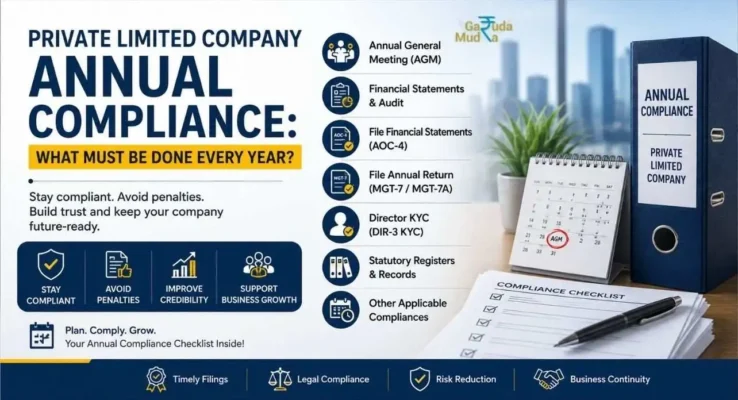
Running a Private Limited Company in India involves more than managing customers, employees, sales and finances. Once a company is incorporated, it carries continuing legal and regulatory responsibilities under the Companies Act, 2013 — responsibilities that continue even if the company has little or no business activity during a financial year.
Quick Answer: A Private Limited Company generally needs to maintain statutory books and records, prepare and audit its financial statements where applicable, hold its Annual General Meeting (AGM), file its financial statements through the applicable AOC form, file its annual return through the applicable MGT form, complete director-related compliances such as DIR-3 KYC where applicable, and comply with other event- or company-specific requirements. The exact list depends on the company’s size, status, activities and transactions.
On this page
What Is Private Limited Company Annual Compliance?
Private Limited Company annual compliance refers to the recurring statutory and regulatory activities that a company is required to complete during or after each financial year. These compliances help the Ministry of Corporate Affairs (MCA) and Registrar of Companies (ROC) maintain updated information about companies registered in India.
Annual compliance can involve financial statements, the annual return, the AGM, board meetings, statutory audit, auditor-related filings, director KYC, statutory registers, shareholding information, related-party information, loans and investments, MSME payment reporting where applicable, deposit-related reporting where applicable, and other sector- or transaction-specific filings. The important point is that annual compliance is not a single form — it is a collection of obligations that depend on the company’s circumstances.
Is Annual Compliance Mandatory for a Private Limited Company?
Yes, generally. A Private Limited Company does not stop having compliance responsibilities simply because it has no sales, no employees, has not generated profit, has not issued invoices, is temporarily inactive, or its directors aren’t actively operating the business. Companies Act requirements continue to apply unless a specific exemption, status or provision changes the obligation.
The Companies Act requires companies other than OPCs to hold an AGM each year, subject to the statutory framework and applicable exceptions. Similarly, annual financial statements and annual-return filing requirements arise under the Companies Act and applicable rules.
Private Limited Company Annual Compliance Checklist
| Compliance | Common Form / Requirement | Typical Timing |
|---|---|---|
| Financial Statements | AOC-4 / applicable AOC form | Within prescribed period after AGM |
| Annual Return | MGT-7 / MGT-7A where applicable | Within prescribed period after AGM |
| Annual General Meeting | AGM | Generally within 6 months of FY end |
| Statutory Audit | Audited financial statements | Before AGM where audit applies |
| Board Meetings | Board meeting requirements | Throughout the year |
| Director KYC | DIR-3 KYC / applicable web-based KYC | Generally by 30 September where applicable |
| Auditor-related compliance | Appointment / reappointment / change | Event-based / applicable statutory timeline |
| MSME Form I | MSME-1 | Where applicable |
| DPT-3 | Return of deposits / specified transactions | Where applicable |
| Beneficial ownership | BEN-2, etc. | Event-based where applicable |
| Other ROC filings | Various forms | Depending on event/transaction |
Important: This table is a practical overview, not a universal checklist for every company. Certain requirements apply only when specific thresholds, transactions or conditions are met.
The Key Compliance Areas, Explained
1
Hold the Annual General Meeting (AGM)
Under Section 96 of the Companies Act, every company other than an OPC is generally required to hold an AGM every year. Subsequent AGMs are generally required within six months from the close of the financial year — so for a company with a 31 March year-end, the AGM is generally expected by 30 September, subject to specific statutory requirements. At the AGM, shareholders may consider adoption of financial statements, the Board’s report, the auditor’s report, appointment/reappointment of directors and auditors, and declaration of dividend, where applicable.
2
Prepare the Company’s Financial Statements
Before annual filings can be completed, the company needs to prepare its Balance Sheet, Statement of Profit and Loss, Cash Flow Statement (where applicable), Notes to Accounts and other prescribed information. Section 134 of the Companies Act specifically addresses approval of financial statements by the Board and accompanying reports.
3
Get the Financial Statements Audited
A Private Limited Company generally has statutory audit requirements under the Companies Act, subject to applicable law and exemptions. This makes the annual process: Accounting → Financial Statements → Audit → Board Approval → AGM → MCA Filing. Companies that delay bookkeeping risk a chain reaction — late accounts lead to a late audit, late AGM preparation and late filing.
4
File Financial Statements Through AOC-4
MCA identifies AOC-4 as the filing of financial statements and other documents with the Registrar — including, depending on the company, the auditor’s report, Board’s report and other prescribed attachments. For a standard company, financial statements are generally filed within 30 days of the AGM, subject to applicable provisions.
5
File the Annual Return Through MGT-7 or MGT-7A
The annual return contains information relating to the registered office, principal business activities, share capital, shareholding, directors, members, indebtedness and changes during the year. The Companies (Management and Administration) Amendment Rules provide that companies generally file MGT-7, while One Person Companies and Small Companies use MGT-7A from FY 2020-21 onward. Not every Private Limited Company should automatically use MGT-7A — the company should first determine whether it qualifies as a Small Company under the applicable provisions and current thresholds.
6
MGT-7 / MGT-7A Due Date
The annual return is generally filed within 60 days from the date of the AGM. For example, if a company holds its AGM on 30 September, the normal timeline would generally extend to 29 November, subject to applicable law, filing rules and circumstances.
7
Complete Director KYC Compliance
Directors allotted a DIN are required to complete the applicable KYC process under the Companies Act rules. MCA’s current DIR-3-KYC instruction kit states that a person allotted a DIN up to 31 March of a financial year must file the webform on or before 30 September of the immediately following financial year, confirming PAN, mobile number, email, address and other prescribed information. Companies should maintain a KYC calendar for all directors rather than remembering it only when an annual filing is due.
8
Maintain Statutory Registers and Records
Companies are expected to maintain prescribed books and registers — register of members, register of directors, register of charges, register of contracts, share-related records, and minutes of Board and general meetings. MCA compliance is both a filing responsibility and a record-maintenance responsibility.
9
Conduct Board Meetings
Private companies also need to comply with applicable Board meeting requirements — the exact number can vary based on the type of company and available exemptions. Board meetings may deal with approval of financial statements, calling the AGM, loans and investments, related-party matters, and other business decisions requiring Board approval. Minutes and records should be maintained properly.
10
Auditor Appointment and Related Compliance
Section 139 of the Companies Act provides the statutory framework for auditor appointment, while rules prescribe certain classes of companies for auditor rotation — for example, certain private companies with paid-up share capital of ₹20 crore or more, subject to the rules and exclusions. Companies should track the current auditor, date of appointment, term, reappointment, resignation and rotation requirements, along with related MCA filings.
11
MSME Form I — Where Applicable
If the company has outstanding payments to qualifying micro or small enterprise suppliers covered by the applicable MSME reporting requirement, MSME Form I may become relevant. MCA’s order provides for half-yearly reporting, with prescribed filing dates of 31 October (for April–September) and 30 April (for October–March).
12
DPT-3 — Where Applicable
DPT-3 may apply depending on the company’s outstanding money/loan/deposit-related circumstances. MCA’s DPT-3 instruction kit specifies an annual filing date of 30 June for the relevant return of deposits or specified transactions not considered deposits under applicable rules. Companies should review loans, advances and deposits before assuming DPT-3 is irrelevant.
13
Beneficial Ownership Compliance — Where Applicable
Where individuals hold significant beneficial interests through direct or indirect structures, forms such as BEN-1, BEN-2 and BEN-3 may be involved — for example, BEN-2 filing by the reporting company within the prescribed period after receiving the relevant declaration. This is generally event-driven rather than a simple annual filing for every private company.
14
Check Changes in Directors and Key Persons
Appointment or resignation of a director, change in designation, appointment/change of KMP, or a change in authorised signatories may each require a separate MCA filing within specific timelines. It’s a common — and costly — mistake to assume all such changes will simply be captured in the next annual return.
15
Check Share Capital Changes
A new share issue, increase in authorised capital, share transfer, buy-back, preference shares or other capital restructuring may trigger additional ROC compliance, such as SH-7 or PAS-related forms, depending on the transaction.
16
Check Charges and Loans
If the company created, modified or satisfied a charge relating to assets or financing arrangements — such as secured business finance — ROC filings may be required. Companies should review their loan documentation as part of their annual compliance check.
Private Limited Company Annual Compliance Calendar
| Period | Compliance Activity |
|---|---|
| April–May | Close books for previous FY, collect documents |
| May–June | Prepare financial statements and audit schedules |
| June–July | Statutory audit and management review |
| July–August | Board approval, Board’s report and AGM preparation |
| By September | Director KYC where applicable |
| By 30 September | Generally target AGM for FY ending 31 March |
| Within 30 days after AGM | AOC-4 / applicable financial statement filing |
| Within 60 days after AGM | MGT-7 / MGT-7A annual return |
| 30 June | DPT-3 where applicable |
| 30 April / 31 October | MSME Form I where applicable |
| Throughout year | Board meetings, registers and event-based ROC filings |
Note: This is a planning calendar, not a substitute for checking the specific statutory due date applicable to your company and financial year.
What Happens If a Private Limited Company Does Not File Annual Compliance?
Additional Fees & Penalties
Delayed filings can attract additional fees and, depending on the default, statutory penalties or other consequences.
Director-Related Consequences
Certain persistent defaults can affect directors and the company’s compliance status.
Difficulty Raising Finance
Banks, investors and financial institutions may review corporate records during due diligence.
Investor Due Diligence Problems
Fundraising, share sales, acquisitions and mergers can slow down with poor compliance records.
Does a Private Limited Company With No Business Need Annual Compliance?
This is one of the most frequently asked questions — and generally, yes. A company does not automatically become exempt from its corporate compliance obligations because it has no revenue, no invoices, no customers, no employees, or has not conducted business. An inactive company may still have filing and statutory obligations. If a company is genuinely no longer required, the directors should explore the appropriate legal route — remaining compliant while inactive, applying for dormant status where eligible, voluntary strike-off where eligible, or other applicable corporate restructuring options — rather than simply stopping filings.
Private Limited Company vs Small Company Compliance
A company that qualifies as a Small Company may receive certain compliance relaxations under the Companies Act and related rules. One visible difference is annual-return filing: most companies file MGT-7, while OPCs and Small Companies file MGT-7A, as prescribed under the applicable rules. However, being classified as a small company does not mean “no annual compliance is required” — small companies still have corporate compliance obligations, and the exact exemptions should be checked against the company’s current status and applicable law.
Private Limited Company Annual Compliance Documents Checklist
Company Documents
- Certificate of Incorporation
- PAN, TAN, CIN
- MOA & AOA
- Previous MCA filings
Financial & Tax Documents
- Trial balance, P&L, balance sheet
- Ledger & bank statements
- Fixed asset & loan records
- Debtor/creditor information
- GST, income-tax & TDS records
- Other applicable tax information
Corporate & Transaction Documents
- Previous AGM & Board minutes
- Shareholding & director details
- Register of members, share certificates
- Auditor information
- Share transfers/allotments, loans, charges
- MSME supplier & beneficial ownership info
Common Private Limited Company Compliance Mistakes
- Filing Only AOC-4 and MGT-7Annual compliance is broader than two MCA forms.
- Waiting Until SeptemberBy then, accounts, audit and Board documentation may all be pending at once.
- Assuming No Business Means No ComplianceInactive companies can still have statutory responsibilities.
- Using MGT-7A AutomaticallyMGT-7A is intended for OPCs and Small Companies under the applicable rules — not every private company.
- Ignoring Director KYCDirector KYC is a separate compliance area with its own deadline.
- Forgetting Event-Based FilingsA company may have annual filings plus separate filings for events occurring during the year.
- Not Reconciling MCA DataShareholding, directors, registered office and capital records should be reviewed for consistency.
How to Make Private Limited Company Compliance Easier
- Maintain a Compliance CalendarTrack due date, form, responsible person, required documents, status, filing date and SRN in one place.
- Close Accounts EarlyDon’t wait until September to start bookkeeping and reconciliation.
- Maintain Corporate Records Throughout the YearKeep Board resolutions, minutes and transaction documents organised as they happen.
- Track Changes ImmediatelyWhenever there’s a director change, share issue, loan, registered office change, share transfer or capital change, check whether an ROC filing is required.
- Conduct an Annual Compliance ReviewBefore filing, compare books, tax records, MCA records, shareholding, directors and corporate documents against each other.
Private Limited Company Annual Compliance: A Simple Example
Imagine ABC Technologies Private Limited, an Indian technology company with a financial year of 1 April 2025 – 31 March 2026. It has 2 directors, 4 shareholders, GST registration, business revenue, a statutory auditor, no CSR obligation, and some MSME suppliers. A simplified compliance workflow could look like:
Apr–Jun: Close Books→
Jun–Aug: Audit & Board Docs→
Sep: KYC & AGM→
Post-AGM: AOC-4 & MGT-7/7A
Throughout the year, the company should also review MSME Form I, DPT-3, director changes, share changes, charges, beneficial ownership and other event-based filings — which is exactly why annual compliance should be viewed as a year-round corporate process, not a September task.
Frequently Asked Questions
What is private limited company annual compliance?
It refers to the recurring statutory requirements a Private Limited Company must complete under applicable Indian corporate laws, including financial statements, annual return, AGM, audit and other applicable filings.
What are the main annual compliance forms for a Private Limited Company?
Common annual forms include AOC-4 for financial statements and MGT-7 or MGT-7A, depending on the company’s applicable status. Other forms may apply based on transactions and circumstances.
Is AOC-4 mandatory for a Private Limited Company?
Companies generally need to file their financial statements with the Registrar through the applicable AOC form, subject to the Companies Act and applicable rules.
Is MGT-7 mandatory for every Private Limited Company?
Not necessarily. Small Companies and OPCs use MGT-7A under the applicable rules, while other companies generally use MGT-7.
When is the AGM due for a Private Limited Company in India?
For a company following a 31 March financial year-end, the AGM is generally required within six months from the close of the financial year, subject to the statutory requirements.
How long after the AGM is AOC-4 filed?
The applicable financial statement filing is generally due within 30 days from the AGM, subject to the Companies Act and applicable rules.
How long after the AGM is MGT-7 filed?
The annual return is generally due within 60 days from the AGM.
Does a Private Limited Company with no business need to file annual returns?
Generally, yes. Lack of business activity does not automatically eliminate the company’s statutory filing obligations.
Is statutory audit mandatory for a Private Limited Company?
Private Limited Companies are generally subject to statutory audit requirements under the Companies Act, subject to applicable provisions and exemptions.
Is director KYC required every year?
Applicable DIN holders generally need to complete the prescribed KYC process. MCA’s current instruction kit specifies 30 September as the relevant annual KYC deadline for the applicable DIN holders.
What happens if a company misses MCA annual filing deadlines?
Delayed filings can result in additional fees and, depending on the nature and duration of the default, penalties or other statutory consequences.
Can a Private Limited Company become dormant?
Eligible companies can explore dormant-company status under the Companies Act, but dormant status is not simply achieved by stopping business activity — the company must meet applicable conditions and follow the prescribed process.
What is MSME Form I?
A half-yearly reporting requirement applicable to specified companies for reporting outstanding payments to micro or small enterprise suppliers, with prescribed filing dates of 31 October and 30 April for the respective half-year periods.
What is DPT-3?
A filing concerning deposits and certain transactions/amounts not considered deposits under the applicable Companies (Acceptance of Deposits) Rules. Its applicability depends on the company’s circumstances; MCA’s instruction kit provides 30 June as the annual filing date.
Private Limited Company Annual Compliance Checklist
Corporate Governance & Financial Compliance
- AGM completed
- Board meetings completed
- Minutes maintained
- Statutory registers updated
- Books closed & financial statements prepared
- Statutory audit completed where applicable
MCA Filing & Directors
- AOC-4 / applicable form filed
- MGT-7 / MGT-7A filed
- MCA master data reviewed
- Director details verified
- DIR-3 KYC completed where applicable
- Director changes filed where required
Transactions & Additional Compliance
- Share transfers & allotments reviewed
- Loans & charges reviewed
- Related-party transactions reviewed
- Beneficial ownership reviewed
- MSME Form I & DPT-3 checked
- CSR & sector-specific requirements checked
Final Takeaway
Private Limited Company annual compliance in India is much more than filing two MCA forms. A properly managed annual compliance process generally follows: Bookkeeping → Financial Statements → Audit → Board Approval → AGM → AOC Filing → Annual Return → Director KYC → Additional Applicable Filings — and throughout the year, tracks director changes, share changes, loans, charges, registered office changes, beneficial ownership and other corporate events.
The exact obligations depend on the company’s size, turnover, capital, borrowings, transactions, structure and applicable exemptions. The safest approach isn’t to ask “what two forms do I need to file?” — it’s to ask “what is my company’s complete compliance requirement for this financial year?” That approach helps prevent missed filings and keeps the company prepared for bank finance, investors, due diligence, business expansion and future transactions.
Need Help With Private Limited Company Annual Compliance?
Managing MCA filings, financial statements, AGM documentation and event-based ROC compliances can get complicated when you’re focused on day-to-day operations. Garuda Mudra can support your company with compliance, accounting, tax and financial documentation — helping you maintain a structured, stress-free compliance process.
Disclaimer: This article is intended for general informational purposes for businesses in India and should not be treated as legal, company-secretarial, tax or professional advice. Companies Act provisions, rules, thresholds, forms, filing procedures and deadlines may be amended through legislation, notifications, circulars and MCA updates. The exact compliance obligations of a Private Limited Company depend on its specific facts and circumstances. Companies should verify the current requirements applicable to them with the MCA and a qualified professional before filing.