
Business Loans · India
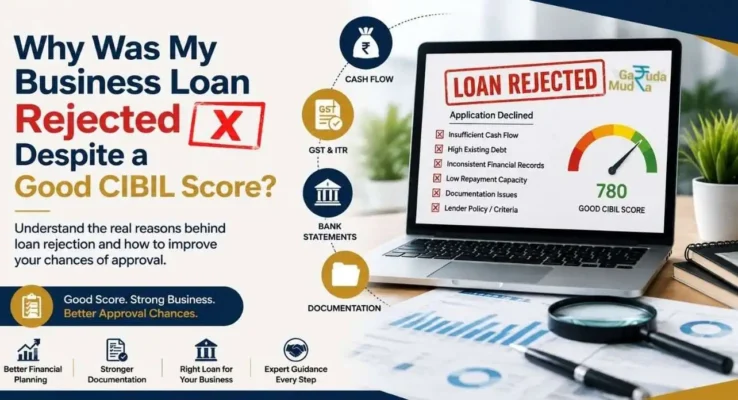
Business Loan Rejected Despite a Good CIBIL Score? Here’s Why
A high CIBIL score helps, but lenders assess cash flow, existing debt, GST/ITR consistency, documentation, business vintage and their own credit policy before approving a loan. Here’s what’s really behind most rejections.
Your business loan may have been rejected despite a good CIBIL score because lenders assess more than your credit score. They may also consider business turnover, profitability, cash flow, existing liabilities, bank statements, GST returns, ITRs, business vintage, loan enquiries, repayment capacity, financial documentation, collateral and the overall risk profile of the business.
A good CIBIL score is helpful when applying for a business loan, but it does not guarantee approval. Banks and NBFCs evaluate several factors before approving business finance, including credit history, existing debt, business cash flow, banking transactions, income, profitability, GST and tax records, repayment capacity, business vintage, documentation and the lender’s own credit policy. This is why a business owner can have a good CIBIL score and still have a business loan application rejected.
For Indian MSMEs and small businesses, understanding these factors can help identify the real reason for rejection and improve the chances of approval in a future application.
Can a Business Loan Be Rejected With a Good CIBIL Score?
Yes. A good CIBIL score indicates a positive credit history, but lenders do not use the score as the only factor in a business-loan decision. For commercial borrowers, credit assessment can involve payment behaviour, debt buildup, utilisation trends, delinquency history and the broader commercial credit profile. TransUnion CIBIL’s commercial credit assessment products, for example, provide lenders with information on commercial borrowers, including behavioural indicators beyond a simple score.
Think of your loan application as having several components:
If one or more of these areas creates a high-risk assessment, the application may still be declined.
10 Reasons Your Business Loan May Have Been Rejected
Your Business Cash Flow Is Too Weak
One of the most important questions for a lender is whether the business can generate enough cash to repay the proposed loan. A business may show good revenue but still have weak cash flow.
Lenders may review bank statements, turnover, profitability, existing EMIs, cash-flow patterns, receivables, payables and existing liabilities. A strong CIBIL score cannot compensate indefinitely for insufficient repayment capacity.
Your Existing Debt Is Too High
Even with a good CIBIL score, a lender may determine that adding another loan on top of an existing business loan, working capital facility, personal loan, credit card balances or vehicle loan would increase the repayment burden too much, leading to rejection or a smaller sanctioned amount.
Your Turnover Doesn’t Support the Requested Loan
Lenders consider the relationship between turnover, profitability, cash flow and the requested loan amount. Asking for ₹50 lakh against a relatively small turnover may create a mismatch — this doesn’t mean the business is weak, just that a more realistic amount, supported by documented cash flows, may have a better chance.
Your Business Has a Short Operating History
A newly established business may not have enough financial history for a lender to confidently assess revenue consistency, profitability, cash flow, customer concentration and seasonal patterns. TransUnion CIBIL’s recent MSME analysis highlights that a significant share of individual borrowers with business-oriented loans are early-stage commercial borrowers, including those with commercial credit histories of less than 24 months — newer businesses are an important part of India’s credit market, but limited history can still affect individual lending decisions.
Your Bank Statements Don’t Support the Application
Lenders may look at the regularity of business receipts, average bank balance, EMI payments, cheque returns, overdraft usage, large unexplained transactions and cash deposits.
Your GST Returns and Books Don’t Match
A problem can arise when GST turnover, bank turnover, books of accounts and ITR income don’t align — for example, GST returns show one level of sales, books show another, and bank credits differ. Before applying, make sure your GST → Books → Bank → ITR → Financial Statements are reasonably consistent, and keep explanations ready for any legitimate differences.
Profitable on Paper, Weak Actual Cash Flow
A business can report a profit while cash is tied up in receivables, inventory, advances, long payment cycles or capital expenditure.
Too Many Recent Loan Applications or Enquiries
Applying to several lenders simultaneously can add multiple credit enquiries to the profile. This doesn’t automatically cause rejection, but a pattern of repeated applications can be one factor in a lender’s overall assessment. A better approach: understand your requirement, review your credit profile and documentation, identify suitable products, and apply to appropriate lenders with a properly prepared application.
Documentation Is Incomplete or Inconsistent
Sometimes the issue isn’t creditworthiness — it’s paperwork. Missing, outdated or inconsistent PAN, KYC, business registration, GST registration, GST returns, ITRs, bank statements, financial statements or ownership documents can delay or decline an application.
The Lender’s Internal Credit Policy May Not Fit
A business can be financially healthy and still not fit a particular bank or NBFC’s policy on industry, vintage, geography, turnover, loan amount, purpose, existing exposure or collateral. A rejection from one lender does not necessarily mean the business is unfinanceable — it may mean the product or lender wasn’t the right fit.
Not sure which of these factors caused your rejection? Get a free loan-readiness review from Garuda Mudra on WhatsApp.
Chat on WhatsAppWhat Do Banks Check Before Approving a Business Loan?
There is no single universal checklist used identically by every bank or NBFC, but an application may be assessed across these broad areas:
| Factor | What the Lender May Evaluate |
|---|---|
| Credit profile | Repayment history, outstanding loans, delinquencies |
| Business financials | Revenue, profit, expenses and financial position |
| Cash flow | Ability to generate cash for repayment |
| Bank statements | Business inflows, outflows and repayment behaviour |
| GST records | Turnover and tax-compliance information where relevant |
| ITR | Reported income and tax information |
| Existing debt | Current loans and repayment obligations |
| Business vintage | How long the business has been operating |
| Loan amount | Whether the requested amount is appropriate |
| Collateral | Security requirements for the particular product |
| Industry | Sector-specific risk considerations |
| Documentation | Completeness and consistency |
| Credit enquiries | Recent borrowing/application activity |
TransUnion CIBIL’s commercial credit assessment describes commercial credit evaluation using factors including credit history, delinquency, debt buildup, utilisation and behavioural trends.
Is CIBIL Score the Same as Business Creditworthiness?
Not exactly. A business loan application can involve both the individual’s personal credit profile (particularly for proprietors or promoters) and the business or commercial credit profile, depending on structure and lender. TransUnion CIBIL provides commercial credit information for entities such as private limited companies, partnership firms and proprietorships, with commercial credit reports containing information about the entity’s credit history and risk profile. So saying “my CIBIL score is 800, my business loan should be approved” is too simplistic — the lender is evaluating overall borrowing risk.
What Should You Do After a Business Loan Rejection?
Don’t immediately submit applications to five more lenders. Follow a structured process instead.
Find out why the application was rejected
Ask whether the issue was credit profile, existing obligations, cash flow, business vintage, documentation, loan amount, industry, banking history or internal eligibility criteria.
Review your credit reports
Check for incorrect outstanding balances, closed loans showing as active, incorrect payment history, duplicate accounts or unrecognised enquiries, and raise a dispute if you find an error.
Review your financial statements
Revenue, gross and net profit, operating expenses, current liabilities, long-term debt, receivables, payables and cash flow — understand how a lender is likely to view the business.
Reconcile GST, bank and tax records
Check whether GST returns, bank statements, books and ITR tell a consistent financial story, and keep documentation ready for legitimate differences.
Review the loan amount
Instead of asking “how much loan can I get,” ask “what amount can my current business cash flow reasonably support.”
Choose the right loan product
Working capital, term loan, equipment finance, expansion funding, invoice finance or an overdraft/credit facility each suit a different purpose.
Can a Business Get a Loan Without Collateral?
Potentially, yes — but collateral-free does not mean automatic approval. For eligible micro and small enterprises registered under MSME/Udyam, credit-guarantee mechanisms such as CGTMSE can facilitate collateral-free credit through participating lenders, subject to the scheme and lender’s applicable conditions. The current CGTMSE scheme provides guarantee coverage for eligible credit facilities within specified limits, while the lending institution still conducts its own credit appraisal. In short: no collateral does not mean no credit assessment — the lender still evaluates the borrower and the business.
What Is CGTMSE and Can It Help After Rejection?
The Credit Guarantee Fund Trust for Micro and Small Enterprises (CGTMSE) was established by the Government of India and SIDBI to facilitate credit access for eligible micro and small enterprises. Eligible credit facilities can receive guarantee coverage, subject to scheme conditions and the lending institution’s eligibility, through the process: Business → Member Lending Institution → Credit Assessment → Loan Sanction → Applicable CGTMSE Guarantee Process. The lender remains responsible for its credit appraisal — CGTMSE does not itself approve a loan.
How to Improve Your Chances of Approval
Clean Credit History
Pay EMIs and other credit obligations on time.
Clean Business Banking
Avoid unnecessary cheque returns; keep predictable transactions.
Proper Books
Financial records should accurately reflect the business — see our bookkeeping services.
File GST & Tax on Time
Keep applicable GST and TDS returns up to date.
Control Existing Debt
Avoid taking on more debt than the business can reasonably service.
Strong Track Record
Consistent revenue and cash flows make the business easier to evaluate.
Sensible Loan Amount
The requested amount should have a clear purpose and repayment logic.
Documents Ready Upfront
A complete application reduces unnecessary delays.
Avoid Random Applications
Identify suitable lenders and products before applying.
Explain the Business Clearly
What it does, how it earns, why the loan is needed, and how it will be repaid.
Business Loan Application Checklist
Business Documents
PAN, GST registration, business registration documents, partnership/LLP/incorporation documents, address proof, relevant licences.
Financial Documents
ITRs, profit & loss statements, balance sheets, bank statements, GST returns, existing loan statements, cash-flow information.
Promoter Documents
PAN, Aadhaar/KYC, address proof, credit history information, other lender-specific documents.
Loan Information
Required amount, purpose, expected tenure, existing liabilities, repayment plan, collateral details if applicable.
The exact documentation varies by lender and loan product.
Business Loan Rejected? Don’t Make These 5 Mistakes
1. Applying everywhere immediately
Multiple applications without understanding the rejection reason may not solve the underlying issue.
2. Blaming only your CIBIL score
Your credit score is only one part of the assessment.
3. Inflating your turnover
Financial records should accurately reflect the business.
4. Ignoring existing debt
A good score does not make excessive leverage disappear.
5. Applying for the wrong loan product
Working-capital needs and long-term expansion funding may require different financing structures.
A Simple Example
Consider a business owner with a good CIBIL score, 3 years in business, ₹60 lakh annual turnover, ₹25 lakh in existing loans, high monthly obligations, some GST inconsistencies, and a ₹40 lakh loan request. The owner may wonder why the application was rejected given a good score — but the lender sees high existing debt, a large requested amount, limited repayment capacity and inconsistent financial records. The issue isn’t the CIBIL score. It’s the overall risk profile.
Frequently Asked Questions
Why was my business loan rejected despite a good CIBIL score?
What CIBIL score is required for a business loan in India?
Can I get a business loan after rejection?
Does a good CIBIL score guarantee a business loan?
Can poor business cash flow cause loan rejection?
Can existing loans cause business-loan rejection?
Can GST turnover affect business-loan approval?
Can a new business get a business loan?
Can I get a collateral-free business loan in India?
Should I apply to another lender after my business loan is rejected?
Final Takeaway
A good CIBIL score is helpful, but it is only one piece of a business-loan application. If your business loan was rejected despite a good credit score, review these areas first: CIBIL → Existing Debt → Cash Flow → Turnover → Profitability → Bank Statements → GST → ITR → Business Vintage → Documentation → Loan Amount → Lender Policy. The goal isn’t simply to find a lender that says yes — it’s to understand why the previous application failed, strengthen the business’s financial profile, and choose a loan structure the business can realistically repay.
Related Reading
Want a professional review of your loan-readiness before you apply again? Talk to Garuda Mudra.
Chat on WhatsAppThis guide is for general information only and does not constitute financial or lending advice. Loan approval criteria vary by lender, product and applicable regulations; confirm current requirements with your bank/NBFC or a qualified professional. — Garuda Mudra, financial, taxation, accounting, compliance & business advisory services.
One thought on “Why Was My Business Loan Rejected Despite a Good CIBIL Score?”