
Need help? Call us:
+91-9711029902
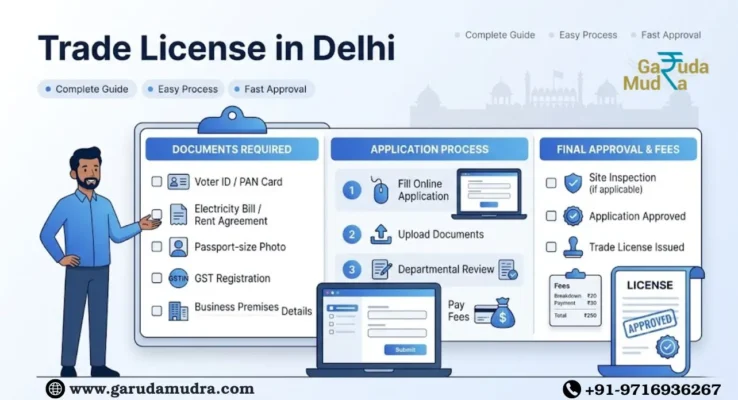
If you are starting or already running a business in Delhi, you may need a trade license from the applicable local authority before carrying out certain commercial activities. One of the most common questions business owners ask is: what documents are required for a trade license in Delhi?
Quick Answer: For businesses under Municipal Corporation of Delhi (MCD) jurisdiction, the General Trade or Storage License process is handled online. The core documents currently identified by MCD include:
- A valid photo identity document of the applicant
- A photograph of the establishment showing the front façade and business activity
- Proof of legal occupancy of the premises
Additional documents may be required depending on the nature of the trade, premises and other applicable regulations.
On this page
- What Is a Trade License in Delhi?
- Which Authority Issues It?
- Documents Required
- Documents Checklist Table
- Additional Documents for Some Businesses
- How to Apply Online (7 Steps)
- Trade License Fee
- Processing Time
- Is It Mandatory?
- Not the Same as GST or Shop & Establishment
- Common Application Mistakes
- Renewal
- Final Checklist
- FAQs
What Is a Trade License in Delhi?
A trade license is a municipal permission that allows an eligible business or commercial establishment to carry out a specified trade or activity in accordance with applicable local regulations. For businesses within MCD jurisdiction, the General Trade and Storage License is issued by the Municipal Corporation of Delhi under the Delhi Municipal Corporation Act, 1957.
MCD states that Section 417 of the DMC Act requires persons establishing businesses covered under the General Trade and Storage licensing framework to obtain the required license, and MCD provides an online application facility for eligible establishments. However, “trade license” in Delhi can refer to different municipal licensing requirements depending on the activity and location — a restaurant, health establishment, factory, warehouse or another regulated activity may have additional licensing or approval requirements.
Which Authority Issues a Trade License in Delhi?
Delhi is not treated as one single municipal licensing jurisdiction for every business — the applicable authority depends on where the premises are located and what type of business is being operated. For businesses within MCD jurisdiction, the Municipal Corporation of Delhi handles General Trade and Storage Licenses through its licensing system; businesses under another local authority may have different procedures and document requirements. Before applying, confirm:
- Where is your business premises located?
- Which local authority has jurisdiction over the premises?
- What type of business or trade are you operating?
- Does the activity require any additional approval or license?
This distinction matters because the MCD General Trade or Storage License document checklist should not automatically be treated as the universal list for every business in Delhi.
Documents Required for Trade License in Delhi
1
Identity Proof of the Applicant
MCD lists identity proof with photograph as a required document. Accepted examples include Aadhaar Card, Voter ID, PAN Card, a valid Indian Passport, Permanent Driving Licence, and bank passbooks with photograph and signature. The identity document should belong to the applicant submitting the license application.
2
Photograph of the Business Establishment
This is an important document that many generic trade license articles fail to highlight. MCD specifically lists a photograph of the establishment showing the front façade, display of goods traded from the premises, or the business being carried out from the premises. Don’t focus only on identity and address documents — prepare a clear photograph of the business premises too.
3
Proof of Legal Occupancy
You need to establish legal occupancy of the premises from which the business operates. MCD lists several types of documents that may establish this, including tenancy proof, electricity connection bill, water connection bill, landline telephone bill, lease deed, sale deed, General Power of Attorney, and government agency allotment letters — the appropriate document depends on the circumstances of the premises.
4
Rent Agreement for Rented Premises
If you operate from rented premises, a rent agreement or other valid tenancy document can help establish legal occupancy. Don’t assume every rental situation has exactly the same document requirement — the application should reflect the actual occupancy arrangement and the documents genuinely available for the premises.
5
Ownership Documents for Owned Premises
If the business premises are owned by the applicant, ownership-related documents such as a sale deed may be relevant. MCD identifies sale deed among the forms of legal occupancy proof that may be used for General Trade or Storage License applications.
Trade License Documents Checklist
| Document | Purpose |
|---|---|
| Aadhaar Card or other accepted photo ID | Applicant identification |
| PAN Card or other accepted identity document | Applicant identification |
| Business establishment photograph | Shows front façade and business activity |
| Rent or tenancy proof | Establishes occupancy of rented premises |
| Lease deed | Establishes legal occupancy |
| Sale deed | Ownership proof, where applicable |
| Electricity or water bill | May support occupancy or premises details |
| Government allotment letter | Occupancy proof, where applicable |
| General Power of Attorney | May support occupancy, where applicable |
| Additional approval or NOC | Only where applicable to the activity or premises |
Important: The exact document requirement depends on the license category, business activity, premises and applicable authority. MCD’s current General Trade License documentation should be checked before submission.
Are Additional Documents Required for Some Businesses?
Yes. The basic MCD General Trade or Storage License checklist should not be confused with the complete compliance requirements for every business. Certain activities may require additional permissions from other authorities — businesses involving food, health, manufacturing, fire safety, pollution control, hazardous materials or other regulated activities may need additional approvals. MCD itself separately identifies Health Trade License and Factory License services, each with their own requirements. Identify the exact activity before assuming a basic trade license is the only approval required.
Who Needs a Trade License in Delhi?
Whether you need a municipal trade license depends on your business activity, premises and applicable local regulations. For establishments covered by the MCD General Trade and Storage License framework, MCD states that traders and establishments operating within MCD jurisdiction need the required license for applicable trade activities. Examples include retail stores, wholesale businesses, storage establishments, commercial trading businesses, certain manufacturing activities, restaurants and food-related businesses, and health-related establishments — though the exact license category depends on the nature of the activity.
Not Sure Which License Category Applies to You?
Choosing the wrong category or missing an additional approval (fire, health, food, pollution) can delay your application. Get it checked before you submit.
How to Apply for a Trade License in Delhi Online
For an MCD General Trade or Storage License, the application process is available online. Read our detailed walkthrough on how to apply for a trade license online in Delhi, or follow the basic process below.
- Identify the Correct License CategoryDetermine whether your business falls under the MCD General Trade or Storage License category — don’t select a category only because the business is located in Delhi. The nature of the trade matters.
- Prepare Your DocumentsKeep applicant identity proof, an establishment photograph, legal occupancy proof and relevant trade details ready before beginning the application.
- Enter Business and Premises DetailsMake sure the business name, applicant details, address, trade description, premises details and area are all accurate and match your supporting documents.
- Upload or Submit the Required DocumentsDocuments should be clear and readable — avoid unclear photographs or documents with missing information.
- Check the Application Before PaymentMCD specifically advises checking the filled information before payment, since errors in business details, premises information or trade classification can cause unnecessary complications.
- Pay the Applicable FeePay through the MCD online system and retain the system-generated registration number for future communication.
- Download the License or Application RecordAfter successful submission, the relevant record or license can be downloaded/printed from the portal — MCD’s current information states the license can be obtained instantly after payment, subject to applicable requirements.
How Much Is the Trade License Fee in Delhi?
The trade license fee in Delhi is not one fixed amount for every business. For an MCD General Trade or Storage License, the applicable license fee depends on factors such as the classification of the trade and the premises. MCD’s licensing framework provides for applicable fees based on the trade and premises, while its published policy also specifies a ₹1,100 registration and processing fee for the relevant application, in addition to the applicable license fee.
Fee Depends On
Type of trade, trade classification, premises category, area of premises, whether new or renewal, applicable municipal fee schedule, and any additional charges or penalties.
Is There a Fixed Fee for Every Business?
No — a small retail establishment and a larger commercial or storage operation will not have the same applicable fee. Determine the exact trade category and premises classification first, then calculate the fee.
Because municipal fee schedules can be updated, always check the current MCD portal before making payment.
What Is the Trade License Processing Time in Delhi?
For an MCD General Trade or Storage License, MCD’s Citizen Charter currently states: Issuance of License: Instant — after payment of the applicable fee, the license can be obtained instantly through the portal. This is different from a generic seven-to-fifteen-working-day estimate. However, instant issuance does not mean every business is automatically exempt from other regulatory requirements — MCD also states that obtaining a license does not provide immunity from action or penalties if there are other violations relating to the premises or applicable requirements.
Is Trade License Mandatory in Delhi?
For businesses covered by the applicable MCD General Trade and Storage License framework, MCD states that obtaining the required license is mandatory within MCD jurisdiction, linked to Section 417 of the Delhi Municipal Corporation Act, 1957. However, whether your particular business needs a General Trade License, Health Trade License, Factory License or another approval depends on the nature of the business and premises — identify the correct license category instead of assuming every business uses the same application.
Trade License Is Not the Same as GST or Shop & Establishment Registration
Trade License vs GST Registration
A trade license relates to municipal permission for applicable trade activities. GST registration relates to India’s goods and services tax system. Having one does not mean you’ve completed the other — a business may need both. See our GST return filing services for the tax side of compliance.
Trade License vs Shop & Establishment
A municipal trade license relates to permission for applicable trade activities under the relevant municipal framework. Shop and Establishment requirements arise under applicable labour and establishment legislation — depending on the business, both may be relevant.
Does a Home-Based Business Need a Trade License in Delhi?
There is no universal yes or no answer. It depends on the nature of the business, location, type of activity, whether customers visit the premises, whether goods are stored, whether employees work from the premises, and applicable municipal rules and jurisdiction. Do not assume residential use automatically permits every type of commercial activity — check the applicable municipal and property rules before starting the activity.
Does a Rent Agreement Work as Proof, and Is Owner NOC Required?
A rent agreement or tenancy proof is relevant where the applicant operates from rented premises — MCD specifically identifies tenancy proof and lease deed among documents that can establish legal occupancy, but the document should accurately reflect the premises actually being used. An owner NOC is not universally mandatory for every application; the exact requirement depends on the premises, occupancy arrangement, trade and applicable rules. MCD’s current checklist focuses on identity proof, establishment photograph and legal occupancy proof — additional documents may be required in specific circumstances.
What Information Should You Keep Ready Before Applying?
Apart from documents, keep the following ready: applicant name and contact details, identity document details, business name and address, nature of business, trade description, premises area, ownership or tenancy details, the establishment photograph, and relevant supporting documents. Keeping information consistent across your application and documents helps reduce errors.
Common Reasons a Trade License Application Can Face Problems
Incorrect Business Address
The address entered should correspond exactly with the supporting premises documents.
Incorrect Trade Description
The selected trade category should accurately represent the actual business activity.
Unclear Documents
Blurry or incomplete documents can make verification difficult.
Missing Establishment Photograph
The establishment photograph is specifically part of the listed documentation for MCD applications.
Incorrect Occupancy Information
The application should accurately reflect whether the premises are owned, rented or otherwise legally occupied.
Ignoring Additional Approvals
Some businesses require other licenses or approvals in addition to the municipal trade license.
Also avoid calculating the fee using an old blog or generic website when MCD has a current applicable fee structure — always verify against the official portal.
Trade License Renewal in Delhi
An MCD General Trade or Storage License is not a lifetime license. MCD’s General Trade License user manual states that the license validity is one year, up to 31 March of the relevant financial year, and is granted or renewed on a financial year basis. For renewal, MCD’s published documentation identifies requirements such as a self-attested copy of the existing license, a self-attested copy of the last license fee receipt, identity proof with photograph, a self-declaration/undertaking within the online application, and a recent passport-size photograph of the applicant. See our dedicated guide on trade license renewal in Delhi for the full process. Renewal requirements and applicable fees should always be checked against the current MCD process.
What Happens If You Operate Without the Required Trade License?
Operating a business without a license when applicable municipal rules require one can create regulatory and financial risks — municipal action, penalties, notices, problems during inspections, difficulty regularising the business, and additional compliance costs. A trade license should be treated as part of the business’s regulatory compliance, not an optional certificate.
Does a Trade License Prove the Property Is Legally Approved?
No. MCD states that a licensee cannot claim immunity from action or penalties merely because a Trade or Storage License has been granted without prior verification or site inspection. A trade license does not substitute for building approval, fire safety approval, property compliance, land use compliance, pollution control consent, food safety licensing or other applicable permissions. The business owner remains responsible for complying with other laws and approvals applicable to the premises and activity.
Trade License Documents Required in Delhi: Simple Checklist
- Photo identity proof
- PAN or another accepted identity document
- Establishment photograph showing front façade and business activity
- Legal occupancy proof
- Rent or tenancy proof, if applicable
- Lease deed or ownership document, where applicable
- Correct description of trade
- Premises area details
- Additional approval or NOC, where applicable
- Correct mobile number and contact details
- Correct business address and trade category
- Applicable fee, payment receipt and application number
The exact requirements should be confirmed against the current MCD application instructions before submission.
Frequently Asked Questions About Trade License in Delhi
What documents are required for a trade license in Delhi?
For an MCD General Trade or Storage License, the core documents include photo identity proof, a photograph of the establishment showing its front façade and business activity, and proof of legal occupancy. Additional documents can apply depending on the business and premises.
What are the documents required for an MCD trade license?
MCD lists photo ID, an establishment photograph and legal occupancy proof as core documents for the General Trade or Storage License application. Accepted occupancy documents can include tenancy proof, utility bills, lease deed, sale deed, GPA or government allotment documentation.
How much does a trade license cost in Delhi?
There is no single fixed fee for every business. For MCD General Trade or Storage License applications, the applicable license fee depends on the relevant trade and premises classification. MCD’s published policy also specifies a ₹1,100 registration and processing fee in addition to the applicable license fee.
How long does it take to get a trade license in Delhi?
For the MCD General Trade or Storage License service, MCD’s Citizen Charter currently states an instant issuance timeline after payment of the applicable fee.
Can I apply for a trade license in Delhi online?
Yes. MCD provides an online application system for General Trade and Storage Licenses.
Is a photograph of the business premises required for an MCD trade license?
Yes. MCD specifically lists a photograph of the establishment showing the front façade and the goods traded or business activity being carried out from the premises.
Is a rent agreement required for a trade license in Delhi?
Where the business operates from rented premises, tenancy proof or a lease document may be used to establish legal occupancy. MCD lists tenancy proof and lease deed among the accepted forms of occupancy documentation.
Is an owner NOC mandatory for every trade license application?
Not necessarily. The exact requirement depends on the premises, occupancy arrangement, trade and applicable rules. The current MCD General Trade License checklist focuses on identity proof, establishment photograph and legal occupancy proof.
Is trade license mandatory for every business in Delhi?
Not every business follows the same licensing category. Businesses covered by the MCD General Trade and Storage License framework require the applicable license within MCD jurisdiction. Other businesses may fall under Health Trade License, Factory License or another regulatory framework.
Is trade license the same as GST registration?
No. Trade license and GST registration serve different regulatory purposes. A business may need both depending on its activities and applicable laws.
Is trade license the same as Shop and Establishment registration?
No. They are separate regulatory requirements and may both apply depending on the business.
Can a home-based business apply for a trade license?
It depends on the nature of the activity, premises, municipal jurisdiction and applicable rules. A home-based business should verify whether its activity is permitted at the premises and whether a municipal license is required.
Does an MCD trade license make a property legally compliant?
No. A trade license does not automatically replace building approval, fire safety requirements, land use compliance, pollution permissions or other applicable approvals. MCD expressly states that issuance of a license does not provide immunity from action or penalties relating to other requirements.
How often does an MCD General Trade License need to be renewed?
MCD’s General Trade License user manual states that the license is valid for one year and up to 31 March of the relevant financial year, with renewal on a financial year basis.
Trade License in Delhi: Final Checklist
If you are preparing to apply for a trade license in Delhi, remember these five points: identify the correct municipal authority; confirm whether your business falls under General Trade and Storage License or another category; prepare photo ID, establishment photograph and legal occupancy proof; check the current applicable license and processing fees; and verify whether your business requires additional approvals such as fire, health, food, pollution or other permissions. For businesses under MCD jurisdiction, the official MCD portal should be treated as the primary source for the latest application requirements, fees and procedures.
Need Help With Trade License Registration in Delhi?
Applying for a trade license can look simple, but choosing the correct license category and preparing the right documents can become confusing — particularly with rented premises, regulated activities or additional approvals. Garuda Mudra can help with trade license document guidance, MCD application support, business premises documentation, trade category guidance, compliance documentation and renewal assistance.
Important: Municipal rules, fees, forms and application procedures can change. The information above is intended for general educational purposes. Always verify the current requirements with the applicable municipal authority before making an application or payment.
One thought on “Trade License in Delhi: Documents Required, Fees & Process Explained”