
Need help? Call us:
+91-9711029902
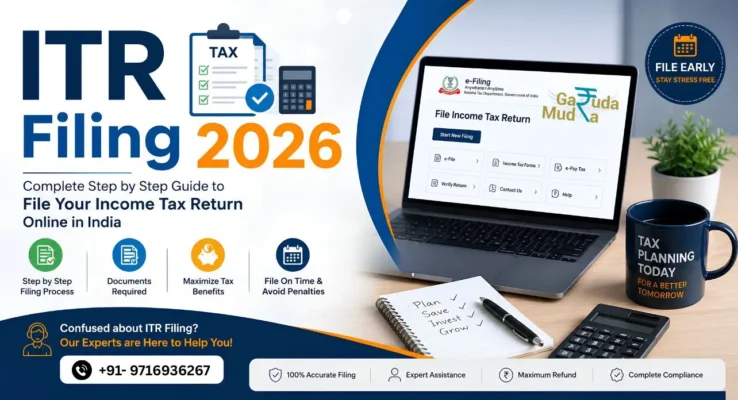
Filing your Income Tax Return (ITR) is no longer just a legal responsibility. In today’s financial world, it has become an essential part of maintaining a healthy financial profile. Whether you are a salaried employee, freelancer, business owner, consultant, startup founder, or investor, filing your ITR on time can help you claim tax refunds, avoid penalties, improve your creditworthiness, and simplify future financial transactions.
With the Government of India continuously improving the Income Tax e-Filing Portal, taxpayers can now complete the entire filing process online within a few steps. However, many people still feel confused about choosing the right ITR form, understanding tax deductions, reporting income correctly, and completing the filing process without errors.
This comprehensive guide explains everything you need to know about ITR Filing 2026 in simple language. From understanding who should file an Income Tax Return to selecting the correct ITR form and avoiding common mistakes, this guide will help you confidently file your return while staying compliant with Indian tax laws.
Whether you are filing your return for the first time or have been filing taxes for years, this guide will answer your questions and help you make informed decisions.
What is Income Tax Return (ITR) Filing?
An Income Tax Return (ITR) is an official document submitted to the Income Tax Department of India that contains details of your income, deductions, taxes paid, investments, and tax liabilities during a financial year.
When you file an ITR, you provide complete information about all your taxable income, including salary, business profits, rental income, capital gains, interest income, and other sources of earnings. Based on this information, the Income Tax Department calculates whether you have paid the correct amount of tax or whether you are eligible for a refund.
Many taxpayers believe that ITR filing is only necessary if they have to pay taxes. However, filing an Income Tax Return offers several benefits beyond tax compliance. It acts as an important financial document that can be used while applying for home loans, education loans, business loans, visas, government tenders, and even certain financial investments.
With digital filing becoming easier every year, taxpayers can now complete the process online without visiting any government office.
Why is ITR Filing Important?
Filing your Income Tax Return on time offers several financial and legal benefits. Apart from complying with the Income Tax Act, timely filing helps maintain transparency in your financial records and prevents unnecessary complications in the future.
Some of the major benefits include:
- Claim Income Tax Refunds if excess tax has been deducted through TDS.
- Carry forward business losses or capital losses to future financial years.
- Improve your financial credibility while applying for loans.
- Support visa applications where income proof is required.
- Maintain proper financial records for investments and business activities.
- Avoid late filing fees, penalties, and interest charges.
- Reduce the chances of receiving notices from the Income Tax Department due to non-compliance.
For professionals, entrepreneurs, and business owners, a regularly filed ITR also demonstrates financial discipline and strengthens business credibility.
Also Read About GST Return Filing
Need Professional Assistance with ITR Filing?
Choosing the correct ITR form, claiming eligible deductions, and reporting income accurately can sometimes be confusing. The tax experts at Garudamudra can help you file your Income Tax Return accurately while ensuring compliance with the latest tax regulations. Connect with us today through WhatsApp or schedule a consultation for personalized assistance.
Who Should File an Income Tax Return in India?
Many taxpayers assume that only individuals with a high income need to file an Income Tax Return. In reality, several categories of taxpayers should file an ITR, even if their taxable income is relatively low.
You should consider filing your Income Tax Return if you fall into any of the following categories:
Salaried Employees
If your total income exceeds the applicable exemption limit, filing an ITR becomes mandatory. Even if your employer has deducted TDS, you should still file your return to reconcile your tax records and claim any eligible refund.
Freelancers and Consultants
Freelancers, digital marketers, software developers, designers, influencers, consultants, and professionals earning income independently should report their professional income through the appropriate ITR form.
Business Owners
Individuals running proprietorship businesses, partnerships, or other eligible businesses must file returns based on their business income and applicable tax provisions.
Investors
If you earn capital gains from shares, mutual funds, real estate, or other investments, filing an ITR helps correctly report these gains and claim applicable exemptions where available.
Rental Property Owners
Income earned from residential or commercial properties must also be disclosed while filing your return.
Senior Citizens
Depending on their income and applicable tax rules, senior citizens may also be required to file an Income Tax Return.
NRIs
Non-Resident Indians with taxable income earned in India should also comply with applicable ITR filing requirements.
Even if filing is not mandatory in your case, voluntarily filing an ITR can provide long-term financial benefits and create a documented record of your income.
Also Read About TDS Return Filing
Documents Required for ITR Filing 2026
Before starting the filing process, it is advisable to collect all the necessary documents. This not only saves time but also minimizes the possibility of mistakes.
Some of the commonly required documents include:
- PAN Card: Your Permanent Account Number (PAN) serves as your primary tax identification number and is mandatory for filing your Income Tax Return.
- Aadhaar Card: Aadhaar is generally required for identity verification and e-verification of your return.
- Form 16: Salaried employees receive Form 16 from their employers, which contains details of salary income and TDS deducted during the financial year.
- Form 26AS: This document shows all tax credits, TDS, TCS, and advance tax payments recorded against your PAN.
- Annual Information Statement (AIS): AIS provides a comprehensive view of your financial transactions, including interest income, securities transactions, dividend income, foreign remittances, and more.
- Bank Statements: Bank statements help verify interest income, investments, and financial transactions.
- Investment Proofs: Documents relating to tax-saving investments, insurance premiums, ELSS, PPF, NPS, tuition fees, and other eligible deductions should be kept ready.
- Home Loan Certificate: Taxpayers claiming deductions on home loan principal or interest payments should obtain certificates from their lending institutions.
- Capital Gain Statements: Investors should maintain records of share transactions, mutual funds, property sales, and other investments.
Keeping these documents organized before beginning the filing process makes the entire experience smoother and reduces the chances of filing inaccurate information.
Also Read About ITR-7 form filing
Step by Step Guide to File ITR Online in India
Filing your Income Tax Return online has become much simpler due to the improvements made to the Income Tax e-Filing Portal. However, following each step carefully is important to avoid errors.
Step 1: Register or Log in to the Income Tax e-Filing Portal
Visit the official Income Tax e-Filing Portal and log in using your PAN and password. New users should first complete the registration process using their PAN, Aadhaar, mobile number, and email address.
After logging in, verify that your profile information, bank account details, and contact information are updated.
Step 2: Select the Appropriate Assessment Year
Choose the correct Assessment Year corresponding to the Financial Year for which you are filing your return. Selecting the wrong assessment year may result in processing delays or rejection of your return.
Step 3: Choose the Correct ITR Form
Selecting the correct ITR form is one of the most important steps in the filing process. Different forms are applicable depending on the nature of your income, residential status, and taxpayer category.
For example, salaried employees with straightforward income generally use ITR-1, while business owners, professionals, and taxpayers with capital gains may need different forms.
Taking professional advice can help ensure that the correct form is selected, reducing the chances of notices or revised returns.
Step 4: Verify Your Pre Filled Information
After selecting the appropriate ITR form, the Income Tax e Filing Portal automatically displays much of your financial information. This includes details collected from your employer, banks, financial institutions, mutual fund companies, stock brokers, and other reporting entities.
Although the information is pre filled, you should never assume that it is completely accurate. Spend some time reviewing each section carefully and compare it with your own documents such as Form 16, Form 26AS, Annual Information Statement (AIS), salary slips, bank statements, and investment proofs.
Pay special attention to:
- Personal information
- PAN and Aadhaar details
- Bank account numbers
- Salary income
- Interest earned from savings and fixed deposits
- Dividend income
- Tax Deducted at Source (TDS)
- Advance tax payments
- Capital gains from shares or mutual funds
Even a small mismatch can delay your refund or trigger a notice from the Income Tax Department. Taking a few extra minutes to verify everything can save significant time later.
Step 5: Report All Sources of Income
One of the biggest mistakes taxpayers make is reporting only their salary income while forgetting other taxable income.
Your Income Tax Return should include every applicable source of income during the financial year.
Some common income sources include:
Salary Income: Include your annual salary, allowances, bonuses, and any taxable perquisites received from your employer.
Income from House Property: If you earn rent from residential or commercial property, declare the rental income after claiming eligible deductions under the Income Tax Act.
Interest Income: Many taxpayers forget to disclose interest earned from:
- Savings Accounts
- Fixed Deposits
- Recurring Deposits
- Post Office Deposits
Although banks deduct TDS in certain cases, you are still responsible for reporting the complete interest income.
Capital Gains: If you sold shares, mutual funds, property, gold, or any other capital asset during the financial year, the gains or losses must be reported correctly.
Business or Professional Income: Business owners, freelancers, consultants, doctors, architects, lawyers, digital marketers, software developers, and other professionals should disclose their business or professional earnings using the applicable ITR form.
Other Income: Income from lottery winnings, gifts exceeding prescribed limits, family pension, or any other taxable source should also be disclosed.
Reporting every source of income honestly reduces the risk of future notices and improves compliance.
Step 6: Claim Eligible Deductions
One of the most effective ways to reduce your tax liability is by claiming all eligible deductions.
However, deductions should only be claimed if you have valid supporting documents.
Some commonly claimed deductions include:
Section 80C
Investments made in PPF, ELSS Mutual Funds, Life Insurance Premiums, National Savings Certificates, Tax Saving Fixed Deposits, Sukanya Samriddhi Yojana, and repayment of home loan principal may qualify under this section.
Section 80D
Medical insurance premiums paid for yourself, your spouse, children, or parents may qualify for deduction.
Section 80CCD
Contributions made towards the National Pension System (NPS) may provide additional tax benefits.
Home Loan Interest
Interest paid on eligible home loans can be claimed under applicable provisions.
Education Loan Interest
Interest paid on education loans may also qualify for deductions.
Choosing the correct tax regime and claiming eligible deductions can significantly reduce your tax liability.
Not sure whether you are eligible for additional deductions? The tax professionals at Garudamudra carefully review your financial documents to ensure you claim every eligible deduction while remaining fully compliant with Income Tax regulations. Contact us today for professional ITR Filing assistance.
Step 7: Calculate Your Tax Liability
Once all income and deductions have been entered, the portal automatically calculates your total tax liability.
You may encounter one of the following situations:
- Refund Due: If excess tax has been deducted through TDS or Advance Tax, you will become eligible for an Income Tax Refund.
- Tax Payable: If additional tax is payable, complete the payment online before submitting your return.
Always review the tax computation carefully before proceeding.
Step 8: Review Every Detail Carefully
Before clicking the Submit button, carefully review your entire return.
Check:
- Name spelling
- PAN
- Aadhaar Number
- Mobile Number
- Email Address
- Bank Details
- IFSC Code
- Income Details
- Tax Paid
- Deductions
- Refund Amount
Many taxpayers rush through this stage and later discover avoidable mistakes.
Step 9: Submit Your Return
Once everything has been reviewed, submit your Income Tax Return through the e Filing Portal.
After submission, an acknowledgement number is generated.
Download and save the acknowledgement for future reference.
Step 10: Complete e Verification
Submitting your return is not the final step.
Your return is considered complete only after successful e Verification.
You can verify your return using:
- Aadhaar OTP
- Net Banking
- Digital Signature Certificate
- Demat Account
- Bank Account Verification
Failure to complete e Verification within the prescribed timeline may result in your return being treated as invalid.
Also Read About File ITR-2 Form Online
Common Mistakes to Avoid During ITR Filing
Even experienced taxpayers sometimes make mistakes while filing their Income Tax Return. Avoiding these common errors can save you from unnecessary notices, penalties, and refund delays.
Choosing the Wrong ITR Form
Using an incorrect ITR form is one of the most common reasons for defective returns. Always choose the form based on your income sources and taxpayer category.
Ignoring AIS and Form 26AS
Many taxpayers rely only on Form 16. However, AIS and Form 26AS contain additional information that should always be verified.
Forgetting Interest Income
Interest earned from savings accounts, fixed deposits, or recurring deposits is taxable in many cases and should not be ignored.
Incorrect Bank Details
A simple mistake in your bank account number or IFSC code may delay your refund.
Claiming Unsupported Deductions
Only claim deductions supported by proper documentation.
Delaying e Verification
Many taxpayers submit the return but forget to verify it.
Without verification, the filing process remains incomplete.
Also Read About GST Registration
Benefits of Filing Your ITR Before the Due Date
- Filing your Income Tax Return well before the deadline offers several advantages.
- Firstly, you avoid last minute technical issues that commonly occur when the filing portal experiences heavy traffic near the due date.
- Secondly, early filing ensures quicker processing of your return and faster refunds.
- It also gives you sufficient time to correct any mistakes or respond to notices if required.
- Financial institutions often ask for recent ITR copies while processing loans, and filing early ensures these documents are readily available.
- Most importantly, timely filing demonstrates responsible financial behaviour and helps maintain a positive compliance history with the Income Tax Department.
Whether you are a salaried employee, freelancer, consultant, startup founder, or business owner, Garudamudra can simplify the entire filing process for you.
Our experienced tax professionals ensure:
- Correct ITR Form Selection
- Maximum Eligible Deductions
- Accurate Income Reporting
- Timely Filing
- Complete Compliance
- Dedicated Tax Support
Connect with our experts today and file your Income Tax Return with complete peace of mind.
Conclusion
Income Tax Return Filing should never be viewed as just another annual compliance activity. Instead, it is an essential financial practice that helps individuals and businesses maintain transparency, improve financial credibility, and stay compliant with Indian tax laws.
By collecting your documents in advance, selecting the appropriate ITR form, reporting all income accurately, claiming eligible deductions, and verifying your return on time, you can complete the filing process confidently and avoid unnecessary complications.
If you find the process confusing or simply want expert guidance, seeking professional assistance can save both time and money. At Garudamudra, our experienced tax consultants help individuals, professionals, startups, and businesses file their Income Tax Returns accurately while maximizing eligible tax benefits.
Frequently Asked Questions (FAQs)
Q1 : What is ITR Filing?
ITR Filing is the process of submitting details of your annual income, deductions, taxes paid, and financial transactions to the Income Tax Department of India.
Q2: Is filing an ITR mandatory?
It depends on your income, financial transactions, and other prescribed conditions. Even if it is not mandatory, filing an ITR is beneficial for claiming refunds, applying for loans, and maintaining financial records.
Q3: Can I file my Income Tax Return online?
Yes. The Income Tax Department provides an online e Filing Portal where taxpayers can file their returns securely.
Q4: Which ITR form should I choose?
The correct ITR form depends on your income sources, residential status, and taxpayer category. Choosing the wrong form may delay processing.
Q5: What documents are required for ITR Filing?
Common documents include PAN, Aadhaar, Form 16, Form 26AS, AIS, bank statements, investment proofs, and home loan certificates.
Q6: How long does it take to receive an Income Tax Refund?
Refund timelines vary depending on successful verification and processing by the Income Tax Department.
Q7: Can I revise my ITR after submission?
Yes, eligible taxpayers can file a revised return within the permitted timeline if they discover any errors.
Q8: What happens if I miss the ITR filing deadline?
Late filing may attract penalties, interest, and restrictions on carrying forward certain losses.
Q9: Do freelancers need to file an ITR?
Yes. Freelancers and consultants are generally required to report their professional income using the applicable ITR form.
Q10: Is e Verification compulsory?
Yes. Your return is considered complete only after successful e Verification.
Q11: Can I claim deductions under both tax regimes?
No. The deductions available depend on the tax regime you choose, subject to applicable provisions.
Q12: Why should I choose Garudamudra for ITR Filing?
Garudamudra provides expert guidance, accurate tax filing, deduction optimization, compliance support, and personalized assistance to make your ITR filing process simple, secure, and stress-free.
6 thoughts on “ITR Filing 2026: Complete Step by Step Guide to File Your Income Tax Return Online in India”